Book review
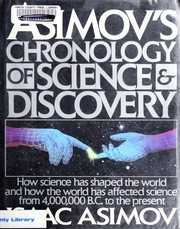
Asimov's Chronology of Science and Discovery Review
A critical guide to Isaac Asimov's vast chronological history of scientific ideas, inventions, and their social setting.
- Author
- Isaac Asimov
- First published
- 1989
View source
https://openlibrary.org/works/OL46220WAsimov's Chronology of Science and Discovery review: a map of change across time
This Asimov's Chronology of Science and Discovery review begins with the book's most important choice: Isaac Asimov organizes scientific knowledge by time. Instead of separating astronomy, medicine, chemistry, physics, engineering, and biology into sealed compartments, he places discoveries and inventions along a common historical line. The result is less a conventional narrative than a very large map, one designed to show scientific work occurring amid cultural, social, and political change.
That design gives the book its durable value. Scientific history can become a parade of names, or it can harden into a collection of specialized disciplinary accounts. Asimov aims for a middle route. The chronological sequence supplies momentum and makes comparison possible, while individual entries allow readers to stop at a period, person, device, or idea without having to master an entire field first. The book is therefore useful both as an orientation to the science and nature shelf and as a bridge into history and ideas.
The thesis of this review is that Asimov's Chronology of Science and Discovery succeeds best as a tool for seeing adjacency. It helps readers notice that advances do not arrive in disciplinary isolation and that the meaning of a discovery depends partly on the world prepared to receive it. Its weakness is the reverse side of that achievement: a single ordered timeline can make a complicated, disputed history look more settled and cumulative than it was. Read as a lucid late-twentieth-century map, the book remains valuable. Read as a final authority on scientific history or present knowledge, it asks too much of its form and its age.
What the chronological structure makes visible
Open Library describes the book as beginning in deep prehistory and proceeding to the author's present, with entries on major breakthroughs arranged in chronological order. The 1989 first edition is cataloged at 707 pages and includes indexes. Those details matter because they clarify the reading contract. This is a substantial reference work, but its architecture is meant to reduce friction: time is the main organizing principle, and the indexes provide a second route when readers arrive with a specific subject in mind.
Chronology can reveal relationships that a topic-by-topic encyclopedia hides. A development in navigation may sit near advances in astronomy; a medical change may become more intelligible beside new instruments, institutions, or ways of measuring. Political expansion, war, commerce, education, and print culture can alter what is investigated and how knowledge travels. The sequence encourages readers to ask not only, "What was discovered?" but also, "What else had to exist for this discovery to become possible or consequential?"
That is a serious intellectual advantage. Scientific knowledge is often presented after its uncertainty has been cleaned away. A finished law, method, or device can appear inevitable once it has a familiar name. A chronology partly restores contingency by surrounding it with earlier attempts and neighboring changes. Even when the entries are concise, their placement suggests that inquiry is cumulative, social, and dependent on tools of communication as well as individual insight.
Yet sequence is not explanation by itself. Two events placed beside one another are not necessarily causally connected, and the date attached to a discovery may compress years of argument, distributed labor, or later recognition. The book is most productive when its dates are treated as coordinates for further inquiry, not as self-sufficient accounts of how knowledge was made.
Asimov's clearest strength: scale without complete fragmentation
Asimov was both a writer and a biochemist, and his nonfiction career ranged well beyond the science fiction for which he is most widely known. That background helps explain the ambition here. He writes for general readers while respecting the fact that scientific history crosses many fields. The book's size allows breadth, while the entry-based form prevents breadth from becoming one unbroken wall of exposition.
The first major strength is navigation. A reader can follow the sequence from one period to another, consult an indexed subject, or browse until an unexpected connection appears. Each method serves a different kind of curiosity. Sustained reading emphasizes change over time; consultation emphasizes retrieval; browsing emphasizes surprise. Few ordinary narrative histories can support all three uses so naturally.
The second strength is contextual reach. The book's catalog description explicitly emphasizes interaction between science and cultural, social, and political events. That framing resists the weakest version of heroic discovery history, in which isolated geniuses simply produce correct ideas ahead of everyone else. Asimov still works within a compact chronology, so he cannot dissolve the heroic model entirely, but he opens the door to questions about institutions, conditions, consequences, and public response.
The third strength is confidence of explanation. A chronology this long needs decisive selection or it will collapse into undifferentiated detail. Asimov's method gives the reader a clear route and a stable scale. The tradeoff is that selection remains the author's judgment. What receives an entry, what receives more space, and what becomes a transition all shape the history being told. Clarity is therefore an achievement, but it should not be mistaken for neutrality.
The limitations of a grand timeline
The largest caution is present-day use. A science reference first published in 1989 is now itself a historical artifact. Later editions may extend the endpoint, but neither the original sequence nor an early-1990s update can represent current scientific knowledge. Readers should not use the book to settle contemporary questions in medicine, climate science, genetics, computing, cosmology, or any other fast-changing field. Its continuing value lies in orientation and intellectual history, not up-to-date instruction.
The second caution concerns the idea of progress. Chronology naturally points forward. Page follows page; one technique supersedes another; an error seems to prepare a correction. Real scientific change is less orderly. Fields can advance at different speeds, promising programs can fail, neglected ideas can return, and social power can determine whose work becomes visible. Knowledge may accumulate, but the institutions that produce it are neither frictionless nor uniformly just.
This matters especially in a work covering enormous spans of time and many societies. Any single-volume chronology must compress disagreements about priority, translation, preservation, collective labor, and cross-cultural transmission. Readers should remain alert to the difference between a useful overview and a complete account. A date and a name can start research; they rarely finish it.
The third caution is source transparency. Open Library's description of the first edition notes that it has no bibliography, although it does include indexes. An index helps locate material inside the book; a bibliography helps readers trace claims beyond it. The absence of the latter makes the volume less useful as a scholarly launching point than its breadth might suggest. Readers using it for study should verify significant claims through current specialist histories and primary or institutional sources.
None of these limits makes the book obsolete. They define its proper use. An older map can still show how a broad subject was organized, what connections an influential explainer considered important, and how late-twentieth-century readers were invited to imagine scientific development. It simply cannot substitute for a current atlas.
Ideal readers and the right way to approach the book
The strongest fit is the curious general reader who wants range before specialization. Someone uncertain whether to pursue the history of medicine, astronomy, technology, biology, or physics can use the chronology to identify periods and questions worth following. The book also suits readers who enjoy dipping into large reference works and building their own paths through them.
Teachers, students, and discussion groups may find it useful as a question generator, provided factual claims are checked against newer sources. Choose a short period, compare several entries, and ask what the timeline foregrounds or omits. Which developments are treated as turning points? How much attention goes to instruments, institutions, or collaboration? Where does a social event appear as context, and where might it deserve to become part of the explanation? Those questions turn the book from a storehouse of answers into an exercise in historical method.
It is a weaker fit for readers seeking one continuous argument, vivid biography, or a modern narrative driven by scenes and characters. The short-entry design privileges connection and coverage over sustained interpretation. Specialists may also find familiar subjects compressed beyond usefulness. For them, the book is likelier to function as an artifact of science communication than as a research reference.
The most rewarding approach is neither to race from beginning to end nor to consult isolated entries without context. Read in clusters. Follow a decade or a problem across adjacent developments, then use the index to see how the same subject appears elsewhere. That alternation between sequence and retrieval makes the structure do more than either method could alone.
Historical context and Asimov's explanatory project
Published near the end of Asimov's career, the book belongs to his long effort to make scientific subjects accessible to nonspecialists. His position as a trained biochemist and prolific public writer is relevant, but it should not become a shortcut to unquestioned authority. Expertise in one scientific field does not make any author the final historian of every field. What Asimov brings is a practiced ability to organize technical abundance for a broad audience.
That organizing skill is the book's real signature. Rather than making one grand argument about why science developed, he creates a framework in which many developments can be seen together. The method reflects an encyclopedic confidence characteristic of large reference publishing: the belief that a sufficiently careful sequence can render a vast body of knowledge intelligible.
Today, that confidence is both attractive and instructive. Readers live with searchable databases and constantly revised online resources, yet those tools do not automatically provide shape. Asimov offers shape. His chronology makes choices visible because every inclusion occupies a place in a finite book. Digital abundance can answer a narrow query faster, but it may not produce the same long view of neighboring events.
The book therefore sits comfortably between reference and interpretation. It is not merely a list, because placement creates meaning. It is not a conventional narrative history, because entries and dates remain the structural units. Readers who understand that hybrid form are more likely to appreciate what it achieves without overlooking what it compresses.
Alternatives and a broader reading route
Readers who want a more continuous, panoramic narrative of human inquiry may prefer Daniel J. Boorstin's The Discoverers. Its organizing choices differ, but it raises a similar question about how a large history turns many acts of knowledge into one readable path. Readers should bring the same caution to both books: narrative sweep always depends on selection, framing, and omission.
For a focused example of ambitious science communication, Stephen Hawking's A Brief History of Time offers a useful contrast. Hawking narrows the field toward cosmology and fundamental physics, trading Asimov's chronological breadth for conceptual concentration. Carl Sagan's Cosmos provides another comparison, joining scientific explanation to cultural and civic imagination in a more sustained authorial voice.
The best route is not necessarily to choose one of these books against the others. Start with Asimov when the primary need is orientation across centuries and disciplines. Move to a broad narrative when continuity matters more than quick consultation, or to a focused work when one domain has become compelling. The site's reading paths can help turn that first curiosity into a sequence rather than an isolated selection.
That route also clarifies what this chronology does uniquely well. It does not ask readers to accept one field as the center of science. It invites movement across fields and eras. Its best outcome is not memorization of dates but the recognition that discoveries have neighbors, predecessors, enabling conditions, and consequences.
Final assessment
Asimov's Chronology of Science and Discovery is a substantial, accessible map of scientific change and a strong example of Isaac Asimov's talent for organizing complexity for general readers. Its chronological architecture supports browsing, consultation, and long-range comparison, while its attention to wider events reminds readers that science develops inside history rather than outside it.
The same architecture requires discipline. Dates can simplify disputed processes, sequence can resemble inevitability, and an older reference work cannot provide current scientific guidance. The first edition's lack of a bibliography further limits its use as a source-tracing tool. These are not minor qualifications; they are the conditions under which the book should be recommended.
For readers willing to use it as a map rather than a verdict, the book remains rewarding. It can reveal patterns, generate questions, and point toward more specialized histories. Its achievement is not that it contains the final story of science. It is that it gives an enormous subject a navigable form—and makes the reader want to investigate what lies between the dates.


