Book review
Atom Review
This Atom review argues that Lawrence Maxwell Krauss's 2001 popular-science book succeeds as an imaginative history of matter, using the path of an oxygen atom to connect cosmology, stars, Earth, and life, though it now works best as lucid exposition rather than current scientific reference.
- Author
- Lawrence Maxwell Krauss
- First published
- 2001
View source
https://openlibrary.org/works/OL50652WAtom review: one oxygen atom as a history of the universe
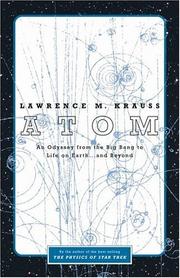
This Atom review has to start by clearing up the identity of the book itself. The work under review is Lawrence M. Krauss's 2001 popular-science book Atom: An Odyssey from the Big Bang to Life on Earth...and Beyond, not a chemistry manual, not a technical introduction to atomic theory, and not a current reference guide to modern physics. That distinction matters because the title is so broad. Krauss is writing for general readers, and his method is literary as much as explanatory: he uses the long career of an oxygen atom as a thread that can connect early-universe physics, the birth and death of stars, the making of planets, the emergence of life, and the eventual fate of matter.
That design gives the book both its charm and its limits. Atom is at its best when it persuades the reader that matter has a history, and that the same physical story runs from cosmic violence to the air we breathe and the bodies we inhabit. It is less effective if you come to it wanting a careful course in contemporary physics or chemistry. The thesis of this review is therefore simple: Atom remains worth reading because Krauss finds a vivid narrative form for very large scientific ideas, but the book works best now as ambitious exposition from its moment rather than as an up-to-date scientific map.
In Online Library terms, it belongs naturally in both science and nature and history and ideas. It explains scientific concepts, but it also asks a historical question about matter itself: where did the stuff of the world come from, how did it move through different systems, and why should ordinary readers care about that journey? Krauss's answer is that once you follow one atom across enough time, the universe stops looking like a collection of separate topics and starts looking like one connected drama.
What Krauss is actually trying to explain
The smartest thing about Atom is that it does not present science as a stack of isolated disciplines. Krauss is not content to talk about cosmology in one compartment, stellar evolution in another, geology in a third, and biology somewhere later on. He wants to show continuity. The atom becomes his organizing device because it can travel where academic boundaries cannot. By following matter rather than one field, he can move from the early universe to stars, from stars to interstellar debris, from debris to planets, and from planets to living systems.
That is a more ambitious project than the breezy premise initially suggests. Many popular science books are good at making one domain legible. Krauss is trying to make scale itself legible. He wants the reader to feel that cosmic history is not an abstraction sealed off from ordinary life. If oxygen in our atmosphere, oceans, and bodies had to be made somewhere, then stellar history is not remote pageantry. It is prehistory of the intimate. The book gains much of its force from that collapsing of distance.
This is also why the book should not be misread as technical advice. Krauss is offering a guided act of understanding, not a handbook for practicing science. He simplifies, compresses, and chooses a pathway through the material. That is not a flaw. It is the contract of the book. But readers will get more from Atom if they approach it as a crafted piece of science communication rather than a definitive account of every subject it touches.
Compared with a landmark like A Brief History of Time review, Krauss is less austere and less narrowly concentrated on theoretical cosmology. Compared with Longitude review, he is less interested in one practical problem and more interested in sweeping continuity across domains. Those comparisons help place the book. It sits in the branch of popular science that wants to unify rather than specialize.
Why the single-atom device mostly works
The most obvious risk in Atom is gimmickry. A weaker writer could have taken the same idea and produced little more than a clever hook for a standard science survey. Krauss mostly avoids that problem because he uses the atom not as decoration but as a way to control movement across scale. The device answers a difficult editorial question: how do you move readers from the Big Bang to biology without making the book feel like a series of disconnected lectures? By fastening the story to matter itself, Krauss gives the reader a recurring point of orientation.
That choice has two important effects. First, it makes abstraction feel directional. Instead of learning one cluster of facts after another, the reader feels carried along a route. Second, it restores contingency and drama to topics that can otherwise sound frozen into textbook certainty. Stars are not just categories in a chart; they are furnaces in which elements are formed. Earth is not merely a setting; it is one stage in a much longer circulation of matter. Life is not treated as a miraculous interruption of physics, but as one astonishing chapter within a physical history that began long before organisms appeared.
Krauss also benefits from writing with a public-facing sense of wonder that does not entirely dissolve into sentiment. He knows the material is inherently awe-inducing, but he does not depend only on awe. He gives the reader sequences, transitions, and causal links. That keeps the book from becoming an inspirational haze about the cosmos. Even when the prose leans enthusiastic, the skeleton of explanation remains visible.
Where the device is less successful is in the speed it encourages. Because the book wants to travel so far, it cannot linger equally everywhere. Some readers will love the momentum. Others will occasionally wish Krauss paused longer with a concept before hurrying onward to the next threshold. That tradeoff is inseparable from the book's design. The same structure that makes it inviting also makes it selective.
The book's real strengths
The first major strength of Atom is conceptual integration. Krauss is unusually good at making the reader feel that cosmology, stellar physics, planetary formation, and biological existence are part of one history rather than a shelf of unrelated specialties. For general readers, that matters more than exhaustive detail. Many people do not need another book that explains one domain in isolation. They need a book that explains why the domains belong together in the first place.
The second strength is readability under difficult scale. Huge numbers, huge timespans, and huge distances can deaden curiosity if a writer presents them as mere enormities. Krauss keeps them active by tying them to transformation. Matter changes state, location, and role. That movement gives the reader something to follow. It is one reason Atom can remain compelling even for readers who already know some of the underlying science. The pleasure is not only in the facts but in the arrangement.
The third strength is tone. Krauss writes with confidence and appetite. He wants the public reader to feel that these questions are worth attention now, not as homework and not as pious admiration for science in the abstract. That urgency helps. The book does not beg for relevance; it generates relevance by connecting distant events to the material basis of everyday life.
There is also a more subtle strength in how the book handles humility. Although Atom is ambitious, it is not trying to prove that one metaphor can replace all scientific reasoning. It is trying to build comprehension through one powerful route. That is a more modest and more durable goal. Readers who enjoy the civic breadth of Cosmos review may find Krauss less lyrical but similarly committed to enlarging the reader's sense of belonging within a vast physical story.
Finally, Atom has strong crossover value for readers who do not normally sort themselves neatly into science subcultures. Someone interested in astronomy, someone interested in Earth history, and someone interested in life's material origins can all find an entry point here. That flexibility makes the book easier to recommend than a narrowly technical title. It is science writing for readers who like connection.
Where the book shows its age
The most important caution is straightforward: this is a book from 2001, and readers should treat it that way. That does not make it obsolete in any simple sense, but it does change the terms of use. Atom is best read as a strong work of early twenty-first-century science communication, not as a current survey of every field it touches. Scientific knowledge moves, emphases shift, and public explanations age along with the conversations that produced them.
That historical framing is especially important because the book ranges across several sciences. The broader the sweep, the greater the chance that some parts will feel more time-stamped than others. A focused book can sometimes age narrowly; a synthesis ages in layers. Modern readers do not need to distrust Krauss to notice that the book belongs to a particular moment in popular cosmology and cross-disciplinary explanation.
The second caution is methodological rather than factual. Krauss values momentum, and momentum always means compression. If you are the kind of reader who wants slow pedagogical staging, with each concept unfolded patiently before the next one arrives, Atom may feel slightly impatient. It is a narrative of connections, not a classroom sequence. That is part of why it can be exhilarating, and part of why it can occasionally feel brisk.
The third caution concerns reader expectation. The title and premise might suggest something like an introductory chemistry book for general audiences. That is not what this is. The atom here is a storytelling path into cosmic and earthly history. Readers looking for a more formal explanation of atomic structure, quantum mechanics, or modern chemistry may feel misaligned unless they adjust early. In that sense the book rewards readers who enjoy argument by analogy and story, rather than only systematic instruction.
If what you want is a more contemporary science book about environmental systems and human intervention in them, Under a White Sky review belongs to a very different but more current nonfiction lane. If what you want is later big-picture reflection about cosmic time and human meaning, Until the End of Time review makes a useful companion or contrast. Atom sits earlier in that continuum of public-facing cosmic explanation.
Reader fit: who should read Atom
This is a good book for readers who enjoy popular science most when it emphasizes unity over specialization. If you like books that show how one question opens onto many fields, Atom is a strong candidate. It is especially rewarding for readers who want to feel the continuity between astronomy and ordinary material life rather than keeping those subjects mentally separate.
It is also a good choice for readers who respond to conceptual storytelling. Krauss knows that a narrative spine can help readers survive difficult scale. He does not turn science into fiction, but he does use storytelling logic to arrange explanatory material. Readers who enjoy that blend often find Atom easier to inhabit than more austere books in physics.
The book is less ideal for readers who want one of three things. First, it is not ideal for readers seeking an up-to-date guide to current scientific consensus across cosmology, chemistry, and biology. Second, it is not ideal for readers who prefer slow tutorial pacing. Third, it is not ideal for readers who want deep technical treatment of one field instead of a broad synthesis. Those readers may still admire the book, but they are less likely to love it.
For students and general readers building a route through science writing, the most helpful question is not "Is this the definitive book on atoms?" It plainly is not trying to be that. The better question is "Do I want a vivid narrative about the history of matter that links the cosmic to the familiar?" If the answer is yes, Atom becomes much easier to place and judge fairly.
Best alternatives and companion reads
The most useful way to read Atom now may be relationally rather than in isolation. If you want a nearby comparison in classic popular cosmology, start with A Brief History of Time review. Hawking is denser, more compressed, and more centered on theoretical questions, but the comparison clarifies what Krauss is doing differently. Hawking asks readers to confront cosmology as a difficult intellectual structure. Krauss asks readers to follow matter through that structure.
If you want a more generous and expansive sense of public wonder, Cosmos review is the obvious companion. Sagan broadens the emotional and cultural horizon of science writing, while Krauss builds a more tightly threaded physical narrative. Reading both makes the contrast vivid: one book is panoramic and civilizational, the other is connective and material.
If you want a later, more elaborated public explanation of related physical ideas, The Fabric of the Cosmos review offers a stronger companion than a rival. Brian Greene is often more patient as a guide, especially for readers who like careful conceptual scaffolding. He is also narrower in scope than Krauss's atom-centered odyssey, which can be an advantage if you want more time with fewer ideas.
One sensible reading route would be:
That sequence moves from wonder and cultural scale to integrative material history to more sustained conceptual explanation. Another route would start with Atom and then move to A Brief History of Time review for readers who discover they want a sterner, more theory-driven next step.
Final assessment
Atom is a smart, energetic, and still valuable piece of popular science because it gives readers a memorable answer to a hard editorial problem: how do you explain the deep history of matter without letting the story fracture into separate disciplines? Krauss's answer is to follow an oxygen atom through cosmic and earthly change, and for long stretches that answer works beautifully. It gives the book shape, pace, and a satisfying sense that the universe is not a pile of disconnected facts but a history of transformations.
Its limitations are real, but they are mostly the limitations of its form and moment rather than signs of failure. The book compresses because it wants movement. It shows its age because it is a 2001 synthesis. It sometimes prioritizes narrative continuity over slower pedagogy because that is how it keeps so many scales in play at once. Readers who know those terms in advance are well positioned to appreciate what the book does well.
The final judgment is clear. Read Atom if you want a professional-grade popular-science book that connects cosmology, stars, Earth, and life through one elegant narrative device. Read it with the understanding that it is explanatory literature, not current scientific instruction. On those terms, it remains an intelligent and rewarding guide to one of the biggest questions science writing can ask: how did the material world that includes us come to be this way?


