Book review
Being Mortal Review
This Being Mortal review considers Atul Gawande's medicine and aging nonfiction through reader fit, strengths, cautions, context, and related books.
- Author
- Atul Gawande
- First published
- 2014
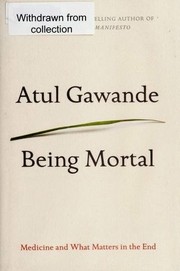
View source
https://openlibrary.org/works/OL17079567WBeing Mortal review: a humane critique of modern medicine's deepest blind spot
This Being Mortal review argues that Atul Gawande's book remains one of the clearest general-audience studies of what medicine does well, what it does badly, and why those failures become most visible when people age, weaken, and approach the end of life. The book is often introduced simply as a nonfiction work about death and dying, but that shorthand undersells its actual achievement. Gawande is not writing a meditation that simply asks readers to accept mortality with grace. He is examining how institutions built to preserve life can become clumsy, evasive, or even counterproductive when the real human question is no longer how to extend life at any cost, but how to protect agency, meaning, and livable reality within finitude.
That distinction matters because Being Mortal is strongest when read not as an inspirational book about courage, but as a critique of professional habits. Gawande is interested in what happens when medical systems become so focused on rescue, intervention, and measurable extension that they lose the ability to ask what a person actually wants the remainder of life to contain. He brings together reporting, case history, family observation, and professional reflection to show how aging and dying expose the limits of a model of care shaped largely by repair. The result is a book with a broad public reputation but a surprisingly specific argument.
My thesis is straightforward. Being Mortal is a serious, durable work of medicine and aging nonfiction because it refuses two comforting simplifications at once: the fantasy that medicine can master mortality, and the fantasy that acknowledging mortality is easy once one has the right vocabulary. Gawande's best pages are unsentimental, lucid, and morally attentive. He is especially good at showing that autonomy is not an abstract principle floating above hospitals and nursing homes, but something lived through rooms, routines, conversations, risk, dependence, and family compromise. Readers interested in science and nature writing that stays close to human stakes will find it essential. Readers looking for a practical manual, a philosophical treatise, or a softer emotional experience should know that the book is more probing than consoling, and more structural than therapeutic.
Medicine, aging, and the question the book refuses to avoid
At the center of Being Mortal is a question many public conversations about healthcare would rather postpone: what is medicine for when cure is no longer the main horizon? Gawande approaches that question through aging, frailty, assisted living, nursing institutions, surgical decision-making, and end-of-life care, but the issue underneath all of those topics is purpose. A medical system trained to fight decline can become uneasy when decline cannot be defeated. In those circumstances, skill alone is not enough. The system also needs a language of limits, tradeoffs, and values.
Gawande's great strength is that he sees how often that language goes missing. He does not portray physicians as indifferent or families as foolish. Instead, he shows how institutional culture shapes everyone inside the room. Doctors are trained to solve problems, families are frightened of relinquishing hope, and patients themselves may be pulled between competing desires: more time, less pain, less dependence, more control, less fear, fewer burdens on others. The book stays compelling because it does not tidy that tension into a single lesson. It treats the conflict as constitutive of modern care.
This is where the book moves beyond issue journalism. A weaker treatment would simply tell readers that the healthcare system needs more compassion. Gawande's claim is tougher and more interesting. He suggests that compassion without structural imagination is not enough. The problem is not only bedside manner. It is the design of institutions, the assumptions embedded in professional training, and the reluctance to define a good life in terms that include risk, preference, and dignity rather than safety alone.
Readers who value books that examine medicine from the perspective of lived human consequence rather than abstract policy will find a productive companion in The Immortal Life of Henrietta Lacks review. Skloot's book is about consent, scientific recognition, and family vulnerability rather than aging, but both writers ask what becomes visible when institutions speak one language and ordinary lives are forced to answer in another.
Narrative method: why Gawande persuades without turning the book into a sermon
One reason Being Mortal reaches readers far beyond medical professionals is that Gawande understands the difference between argument and hectoring. He does not present the book as a polemic built from slogans. Instead, he constructs it through scenes, histories, conversations, and carefully chosen examples that let the reader feel the pressure points before the larger claim is stated outright. That method matters because the subject invites moral overstatement. Books about death, aging, and care can become preachy very quickly. Gawande avoids that trap by trusting narrative sequence.
He is especially effective at moving between scales. A family story opens into a question about elder care design; a professional dilemma opens into a critique of clinical incentives; a seemingly modest observation about daily routine becomes a larger argument about personhood. The book is never merely anecdotal, but it also avoids the dead air of policy prose. Its examples are doing conceptual work. They show how autonomy can be eroded not only through dramatic abuses, but through ordinary routines that look efficient from the outside and diminishing from within.
That is why the book remains readable even for people who are not primarily interested in medicine. Gawande writes with explanatory clarity, but his real asset is narrative calibration. He knows when to stay with a scene long enough for its emotional and ethical implications to register, and when to widen the lens so the reader can see the systemic pattern. The pacing is measured rather than urgent, which suits the material. A shriller version of this argument might have felt more immediately forceful, but it would have had less staying power.
The style also deserves credit. Gawande's prose is direct, purposeful, and unshowy. He rarely reaches for ornamental effect. That restraint is one reason the book's hardest passages land with such force. They are not padded with rhetoric. They rely on observation, sequence, and contrast. In editorial terms, the book understands that moral seriousness is often better served by clarity than by performance.
Readers who want another medically informed book where the narrative voice matters as much as the subject may also consider When Breath Becomes Air review. Paul Kalanithi writes from the inside of terminal illness rather than from Gawande's broader reporting stance, but both books are strongest when they treat medicine as an interpretive problem rather than a machine for producing answers on demand.
Autonomy, dependence, and the book's most important moral insight
The most valuable idea in Being Mortal is not that people fear death. That is obvious. The more difficult insight is that many people fear the conditions surrounding decline at least as much: loss of control, enforced passivity, institutional regimentation, being acted upon rather than listened to, or becoming present in body while absent from decisions. Gawande is sharp on this point. He understands that dignity is not a decorative moral term. It is built out of practical freedoms, even small ones, and can be quietly stripped away long before anyone uses the language of crisis.
This is where the book becomes genuinely illuminating about aging. Popular culture often presents late life through two bad frames: either idealized wisdom or humiliating diminishment. Gawande refuses both. He writes about aging as a condition of changed capacities, competing dependencies, and ongoing personhood. That is a more humane and more exacting frame. It recognizes that the elderly are neither sentimental symbols nor simply bodies in need of management. They remain people with preferences, attachments, tolerances for risk, and different ideas about what makes a day worth having.
The book is especially good on the tension between safety and freedom. Institutions often justify restrictive arrangements as necessary protection, and sometimes they are right. But Gawande insists that safety can become tyrannical when it is treated as the sole good. A life in which every danger has been minimized may also be a life emptied of spontaneity, privacy, appetite, and self-direction. He does not romanticize risk, yet he is clear that a wholly risk-free existence can also be inhuman. That is one of the book's strongest contributions to public discussion.
Importantly, Gawande does not turn autonomy into a fantasy of independence. He knows that dependence is real, especially in illness and age. The book's achievement is to argue for autonomy within dependence rather than autonomy instead of it. That is a much harder moral position. It asks readers to think about care as collaboration rather than custody, and about help as something that should support a person's priorities rather than substitute institutional convenience for them.
Because of that focus, Being Mortal also belongs in conversation with philosophy and psychology, not only with medical nonfiction. The questions it raises are practical, but they are also philosophical in the richest sense: what counts as a good life when ability changes, what forms of choice matter most, and how should people speak honestly when every available option carries some loss.
Where the book is strongest on end-of-life care
Any responsible review of Being Mortal has to be careful here, because this is a book about medicine and dying, not a substitute for medical guidance. What Gawande offers is not treatment advice. He offers a more honest framework for understanding why end-of-life care is so often emotionally and institutionally difficult. That framework is one of the book's deepest strengths.
He shows, first, how easily discussions around serious illness become distorted by the culture of intervention. When a system is oriented toward what can be done, it may not pause long enough to ask what should be done, or what tradeoffs a person actually accepts. The force of this critique lies in how concrete it is. Gawande is not arguing that aggressive care is always wrong or that restraint is always right. He is arguing that meaningful care requires clearer conversations about goals, priorities, and tolerable burdens than many institutions are prepared to host.
Second, the book is strong on how families enter these situations. Loved ones do not approach decisions as neutral observers. They arrive carrying fear, guilt, hope, exhaustion, and their own ideas about duty. Gawande treats this with sympathy. He does not caricature relatives as obstacles to good judgment, nor does he flatter them into sainthood. He shows how love can sharpen clarity in one moment and cloud it in the next. That honesty helps the book avoid the false confidence common in more prescriptive writing.
Third, Gawande persuades because he keeps returning to the lived scale of choice. The question is often not whether life is valuable. Of course it is. The question is what shape of living remains possible, wanted, or bearable under certain conditions. That shift from abstract survival to concrete life is the book's moral hinge. It asks readers to think in terms of days, activities, relationships, tolerances, and definitions of enough. Even readers who resist parts of Gawande's argument will likely come away with a sharper sense of what many public debates leave unsaid.
If your interest lies in the intimate perspective of illness rather than the institutional perspective of care, When Breath Becomes Air review is a strong alternative. If you want a book more concerned with clinical cases and the interpretive relation between doctor and patient, The Man Who Mistook His Wife for a Hat review offers a different but related route through medical storytelling.
Strengths: what makes Being Mortal endure
The first major strength is conceptual clarity. Gawande identifies a central conflict in modern medicine and expresses it in a way general readers can grasp without flattening the difficulty. He does not need exaggerated rhetoric because the argument is already substantial: a culture organized around extending life can neglect the conditions that make life recognizably one's own. That idea is not simple, but the book makes it legible.
The second strength is moral seriousness. Being Mortal is emotionally affecting, but it does not rely on emotion alone. It asks readers to examine their assumptions about aging, care homes, surgical possibility, professional success, and family responsibility. Its authority comes from the combination of observational detail and ethical patience. Gawande is willing to stay inside unresolved problems rather than pretending every case confirms a clean rule.
The third strength is accessibility without triviality. This is one of the hardest balances in serious nonfiction. Gawande writes for a broad audience, yet he avoids the patronizing simplification that can make public-interest books feel disposable. Readers unfamiliar with medical systems can follow the argument; readers already interested in medical ethics can still find enough complexity to stay engaged.
A fourth strength is the book's sustained attention to environment and design. Some of its most memorable passages concern not high drama but ordinary settings: rooms, schedules, institutional norms, built spaces, and the way these shape what counts as independence. That attention keeps the book from dissolving into abstraction. It reminds readers that values are enacted through material arrangements, not just declared in principle.
Finally, the book lasts because it improves the reader's questions. After Being Mortal, it becomes harder to speak lazily about heroic medicine, patient choice, or quality of life. Even readers who disagree with some parts of the argument are likely to think with more precision about what care is for and how authority should be exercised when certainty is unavailable.
Cautions, limits, and where some readers may resist it
The first caution is emotional readiness. This is not a sensational book, but it is a sustained book about frailty, decline, dependence, and death. Readers looking for distance from those themes may find it heavy going. Gawande is too disciplined to manipulate emotion, yet the material itself carries a deep charge. That seriousness is part of the book's value, but it does affect reader fit.
The second caution is that the book is an argument as much as an account. It uses reporting and narrative generously, but it is still shaping material toward a thesis about how medicine should think. Readers who want a neutral overview of late-life care will not quite get that here, and in truth neutrality would probably have weakened the book. Still, it is worth knowing that Gawande is persuading, not merely cataloging.
A third caution concerns scope. Being Mortal is rich on moral framing and strong on the institutional culture of medicine, but it is not the same thing as a comprehensive history of geriatrics, hospice, disability thought, or healthcare economics. Some readers may want more policy depth, more cross-cultural comparison, or more engagement with wider social inequality. Those absences do not undo the book, but they do define its boundaries.
There is also a tonal reservation some readers may feel. Gawande writes with professional poise and evident care, yet the book remains very much the work of a physician writer interpreting systems from within and around his field. That perspective gives the book credibility, but it also shapes what receives emphasis. Readers who prefer more explicitly plural or patient-led frameworks may admire the book while still finding its vantage somewhat bounded.
Those cautions matter because Being Mortal is sometimes praised so broadly that its actual character disappears. It is not a universal handbook for grief, a purely philosophical meditation, or a technical policy text. It is a lucid work of public-facing medical criticism, grounded in narrative and ethics. Read on those terms, it is unusually strong.
Who should read Being Mortal and who may want something different
This is an excellent choice for readers who want to think seriously about aging, medicine, family responsibility, and autonomy without being handed easy reassurance. It is especially good for readers who appreciate nonfiction that joins institutional critique to humane observation. Book clubs, students in health humanities, clinicians reflecting on care culture, and general readers drawn to thoughtful public writing can all get a great deal from it.
It is also a strong fit for readers who respond to nonfiction that changes the language of a topic rather than simply delivering information about it. Gawande gives readers better terms for discussing frailty, dependence, and the goals of care. That is one reason the book remains relevant even for people already familiar with its general reputation.
It may be a weaker fit for readers who want a more intimate memoir, a more explicitly philosophical work, or a broader institutional history. If you want the concentrated first-person force of illness writing, When Breath Becomes Air review is likely the better next read. If you want medical ethics through the lens of consent, race, and scientific recognition, The Immortal Life of Henrietta Lacks review offers a different but equally rewarding path. If you want humane clinical storytelling with a stronger neurological emphasis, The Man Who Mistook His Wife for a Hat review is another worthwhile companion.
For readers browsing more broadly, Being Mortal also works well as a bridge book within the site. It sits naturally between science and nature and philosophy and psychology because it asks empirical and moral questions at the same time. It is not merely about what happens to bodies. It is about what institutions think bodies are for, and what people hope life remains when bodies can no longer obey every demand made of them.
Final judgment
Being Mortal deserves its continuing readership because it makes a difficult public conversation more exact without making it colder. Gawande writes about aging and dying with an unusual combination of sobriety, clarity, and institutional intelligence. He does not pretend mortality is a lesson everyone learns gracefully, and he does not pretend medicine becomes humane automatically just because its practitioners mean well. What he offers instead is sharper moral vision: a way of seeing how care can fail when it confuses prolongation with purpose, and how it might improve when it asks better questions earlier.
That is why the book still matters. Its subject is universal, but its achievement is specific. It shows that the hardest part of medicine is not always technical difficulty. Sometimes it is the courage to recognize that people need more than procedures, protection, and postponed endings. They need room for preference, meaning, and proportion. As a work of public nonfiction, Being Mortal remains one of the most persuasive books on that theme: thoughtful, humane, and still capable of changing the terms of the discussion long after the final page.


