Book review
De ente et essentia Review
A concise but demanding metaphysical treatise that rewards readers who want a clear view of how Thomas Aquinas distinguishes being, essence, and existence.
- Author
- Thomas Aquinas
- First published
- 1480
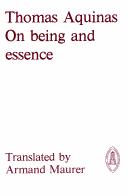
View source
https://openlibrary.org/works/OL546928WDe ente et essentia review: why this short treatise still matters
De ente et essentia review usually begins with a warning about difficulty, but the more useful point is simpler: this is a compact metaphysical treatise whose value lies in precision, not breadth. Thomas Aquinas is not writing a devotional text, a practical handbook, or a modern academic monograph. He is working inside medieval Latin philosophy, where the terms "being" and "essence" are being sharpened into a vocabulary that can carry argument. That makes the work small in size and large in consequence.
The central thesis is straightforward. De ente et essentia matters because it shows how a few carefully chosen distinctions can reorganize an entire philosophical landscape. It is less a narrative than a demonstration of method. Read that way, the treatise becomes a clear example of intellectual history at work: one thinker absorbing inherited concepts, testing their fit, and building a tighter account of what a thing is, what it means to exist, and how those ideas relate.
That is why the book remains worth a place in the catalog. It does not ask to be admired for plot, atmosphere, or emotional range. It asks to be judged by the quality of its distinctions. For readers interested in philosophy, especially medieval metaphysics, that is not a limitation. It is the point.
What De ente et essentia is doing
The book is often described in broad terms, but the content is more exacting than those labels suggest. Aquinas is sorting through the relation between essence, existence, substance, form, matter, and the ways a thing can be known as what it is. The treatise matters because it does not merely list these terms. It tries to show how they connect, where they diverge, and why the difference matters for philosophical explanation.
This is one reason the work has such lasting force in intellectual history. A reader can follow the movement of the argument and see a tradition being clarified in real time. The Latin scholastic context is not decorative background. It is the field in which the treatise becomes legible. Aquinas inherits Aristotelian logic and metaphysics, engages ideas that passed through earlier commentators, and gives the whole arrangement a distinctive shape.
That makes the book more than a historical artifact. It is a model of how philosophy builds from inherited language rather than starting in a vacuum. In other words, the treatise is not just about being and essence. It is also about how philosophical vocabulary is disciplined until it can do real explanatory work.
For that reason, the most accurate way to approach De ente et essentia is as a work of conceptual construction. Summary can state the topic, but it cannot show the method. The method is where the book earns its importance.
Reader fit and likely response
The best readers for De ente et essentia are those who enjoy dense argument and do not need a text to announce its meaning at every turn. Readers with an interest in medieval metaphysics, the history of philosophy, or the architecture of conceptual systems will find the treatise unusually rich. The book is also useful for anyone comparing Aquinas with other philosophical traditions, because it shows how carefully a concept must be handled if it is expected to support a larger worldview.
That same concentration will not suit every reader. Anyone looking for a broad survey, a dramatic arc, or immediately accessible prose may find the treatise austere. The book does not perform warmth for its own sake, and it does not broaden out into many different kinds of experience. Its energy comes from definition, relation, and consequence.
That is not a flaw so much as a contract. Readers who want to understand why medieval metaphysics has remained influential should expect an argument that is narrow in scope but exact in purpose. The reward is not speed. The reward is clarity.
In practical terms, the book fits readers who are willing to move slowly, track distinctions, and accept that a short text can still be demanding. It is especially strong for readers who want a philosophical challenge that is historically grounded rather than merely abstract.
Strengths of the book
The first strength of De ente et essentia is conceptual compression. Very few texts make so much philosophical work happen in so little space. Aquinas keeps the argument tight, which means that each distinction feels consequential. That compression gives the treatise a seriousness that does not depend on length.
The second strength is historical significance. This is not simply a medieval curiosity. It is a document of how scholastic philosophy organizes itself around questions of being, essence, and existence. For readers of intellectual history, the book shows a tradition thinking through its own inheritance with unusual discipline. It is useful both as a primary text and as a map of the problems that later philosophy keeps revisiting.
The third strength is comparative value. De ente et essentia pairs well with other philosophical works because it clarifies what is at stake when a text claims to explain reality at a fundamental level. After reading it, a reader is better positioned to compare a modern introduction, a later scholastic discussion, or a very different kind of argument about human knowledge and classification. That comparison value is one reason it sits comfortably beside Philosophy and Psychology on the site.
The fourth strength is discipline of thought. The treatise does not wander. It decides what it wants to clarify and keeps returning to that task. For readers who value rigor, that consistency is satisfying in itself.
Cautions and limits
The main caution is density. De ente et essentia assumes that the reader is willing to work with unfamiliar terminology and to let the argument unfold without constant simplification. That can be rewarding, but it can also be tiring if the reader arrives expecting a smoother introduction to philosophy.
Another limit is scope. The work is concentrated enough that some readers may mistake its narrowness for incompleteness. In fact, the narrowness is part of the design. Aquinas is not trying to survey every question in metaphysics. He is trying to clarify a foundation. Once that is understood, the text becomes easier to appreciate on its own terms.
A third caution is dependence on context. Because the treatise is so tied to medieval Latin philosophy, it is more legible when placed in a historical frame. Read without that frame, it can seem colder or more technical than it really is. Read with it, the book becomes a carefully staged response to inherited questions rather than an isolated abstraction.
This is also why De ente et essentia should not be treated as guidance in the modern self-help sense. It is not offering instructions about how to live, nor is it presenting theology as a personal consolation. Its work is philosophical and historical, aimed at understanding the structure of reality as Aquinas understands it.
Historical and philosophical context
The treatise belongs to a moment when Latin philosophy was absorbing Aristotelian metaphysics and refitting it inside a broader medieval framework. That context matters because the book is not simply repeating inherited categories. It is making them usable for new argument.
Seen from that angle, Aquinas is doing intellectual synthesis. The text connects the categories of being and essence to a wider philosophical project in which explanation depends on distinctions that are careful, repeatable, and ordered. The result is a compact piece of scholastic writing that remains important because it helps define the questions later readers associate with Aquinas at his most systematic.
This historical placement also helps explain why the treatise continues to be read. It is not only a source for one doctrine. It is a record of how philosophical languages stabilize over time. That makes it valuable for anyone tracing the development of metaphysical thought across traditions.
For readers moving through the catalog, the right context can come from neighboring reviews. Quaestiones Disputatae de Veritate offers another Aquinas text with a different scale and rhythm, while About Philosophy gives a broader and more accessible entry into philosophical questions. Those are not substitutes in a strict sense, but they are useful comparison points.
Alternatives and reading route
If the goal is a more approachable start to philosophical inquiry, About Philosophy is the better first step. It gives a wider orientation and less conceptual pressure, which makes it easier to enter the larger conversation before returning to Aquinas.
If the goal is to stay inside Aquinas but expand the comparison, Quaestiones Disputatae de Veritate is the more obvious companion. That pairing helps show how Aquinas handles related questions in a different format and with a different argumentative pace.
For a later contrast in how systems are argued in prose, Deschooling Society offers a sharply different mode. It is not philosophically adjacent in subject matter, but it is useful as a reminder that a book can be intellectually serious while pursuing a very different style of critique.
Readers who prefer to move by category can also use the broader philosophy and psychology shelf as a route through related titles. That route works well because De ente et essentia becomes clearer when set beside both classic and modern treatments of philosophical structure.
Final assessment
The final judgment is positive, but specific. De ente et essentia is not a book for casual browsing or for readers looking for an easy philosophical overview. It is valuable because it makes a foundational distinction feel exact and consequential. In that sense, the treatise earns its reputation the hard way, through concentration rather than size.
For the right reader, the book is memorable precisely because it is so disciplined. It models a style of thought that is patient, hierarchical, and unusually attentive to definition. That makes it an important part of intellectual history and a strong entry in any philosophy-oriented catalog.
As a review recommendation, the safest summary is this: read De ente et essentia when the goal is not comfort but clarity. The text rewards readers who want to see how metaphysical language is built, refined, and put to work. That is a durable achievement, and it is the reason the book still deserves attention.


