Book review
Every Heart a Doorway Review
A compact, melancholy portal fantasy that turns children’s return from magical worlds into a sharp study of belonging, grief, and chosen community.
- Author
- Seanan McGuire
- First published
- 2016
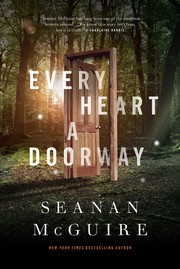
View source
https://openlibrary.org/works/OL17356063WEvery Heart a Doorway review: the return is the real beginning
This Every Heart a Doorway review begins with the book’s most important reversal: Seanan McGuire is less interested in the child who enters a magical world than in the child who is sent back. Portal fantasies often make discovery the reward. A wardrobe, rabbit hole, or impossible door releases a young person from ordinary limits and confirms that another life is possible. McGuire asks what happens when that confirmation is withdrawn. The returned child must live among people who call the experience imaginary, while the lost world remains more emotionally real than home.
That premise gives the novella its force. Nancy arrives at Eleanor West’s Home for Wayward Children after returning from an Underworld whose stillness suited her. The school shelters other young people who crossed into radically different realms and came back altered. Their parents generally want restoration: the familiar child, corrected and returned to normal. Eleanor offers something more humane. She recognizes that these children are not patients waiting to be cured of fantasy. They are displaced people mourning places where their deepest traits once made sense.
The book then introduces a murder mystery, and the tonal shift is deliberate. The danger inside the school prevents its community from becoming an uncomplicated refuge. Yet the mystery is not the novella’s deepest question. The real question is whether a person can build a life after losing the place that provided a complete vocabulary for the self. McGuire’s answer is compassionate but not comforting: recognition matters, companionship matters, and hope can sustain, but none of them neatly cancels grief.
A portal fantasy built from aftermath
The cleverness of the setup lies in how thoroughly it changes the genre’s usual direction of travel. Instead of asking what marvel waits beyond the door, the story asks what the traveler brings back: habits, loyalties, bodily discipline, fear, longing, and a new measure for reality. The children at Eleanor’s school have not simply collected adventures. Their other worlds have shaped them, sometimes in ways that make ordinary family life feel like exile.
Nancy embodies this idea through restraint. She has learned to value silence and stillness, qualities that those around her can mistake for morbidity or passivity. In her lost world, they were forms of fitness and belonging. Back in the everyday world, even her appearance becomes a site of argument between her self-knowledge and her family’s preferred story about her. McGuire uses that mismatch to expose a common cruelty: adults can claim to want a child back while refusing to meet the person who actually returned.
The school allows multiple versions of this displacement to coexist. Some students came from worlds ruled by logic; others from realms of nonsense, beauty, violence, virtue, or appetite. The classification system Eleanor and the students use is playful worldbuilding, but it also performs serious critical work. It rejects the idea that every fantasy world provides the same kind of liberation. A realm that is paradise for one child might be unbearable for another. Belonging depends not only on escape but on the fit between a person’s nature and a world’s demands.
That makes the novella a useful entry point into the broader field of fantasy books, especially for readers interested in how genre conventions can be turned inside out. Its magical geography is expansive, but the narrative remains concentrated on the psychological consequences of crossing boundaries.
The school as refuge, laboratory, and contested home
Eleanor West’s school is one of the book’s strongest inventions because it functions on several levels at once. It is a refuge from disbelieving families, a place where impossible testimony can be spoken without immediate dismissal. It is also a laboratory of affinities and conflicts. The residents understand one another’s broad predicament, but shared loss does not automatically produce harmony. Their worlds rewarded different values, and those values continue to govern how they judge each other.
McGuire therefore avoids a soft version of found family in which recognition erases friction. The students can be kind, territorial, vain, perceptive, or cruel. They form friendships across difference, but they also reproduce hierarchies and exclusions. This tension keeps the school credible. People who share marginalization do not become interchangeable, and a community formed by injury still has to learn how to live.
The setting also intensifies the story’s argument about authority. Outside the school, adults explain the children’s experiences away. Inside it, Eleanor gives their accounts structural weight. She has vocabulary, rules, and practical knowledge developed from listening. That difference is more important than simple belief. Recognition becomes institutional: the school is arranged around the possibility that the children know something true about their own lives.
For readers browsing young-adult books, this is a notable strength. The story takes adolescent self-definition seriously without pretending that young people always understand every consequence. It grants them authority over their identities while allowing them to remain frightened, mistaken, and unfinished.
Characterization through incompatible worlds
The novella handles an ensemble in a small space by making each character’s desired world a compact portrait. A preference for order or chaos, virtue or wickedness, motion or stillness tells the reader how that person wishes to exist. The device is efficient because setting and psychology arrive together. A few details about a vanished realm can imply a whole moral climate, as well as the behavior its former resident learned there.
Nancy remains the emotional center, but her quietness does not mean emptiness. Her attention is active. She observes the school’s performances and learns where its residents’ bravado covers pain. Her reserve also creates a productive tension with more exuberant classmates. The book does not require one mode of being to defeat another; instead, it asks whether radically different people can recognize the legitimacy of needs they do not share.
This is also where the limited length costs the novel most. Several students are vivid at introduction yet receive only enough space to establish a wound, a style, and a narrative function. The compression can make them feel like doorways to books that have not yet been opened. Because the premise generates so many possible histories, the reader may want more ordinary school life, more shifting alliances, and more time for trust to develop before the mystery accelerates.
Still, the incompleteness is partly thematically appropriate. These young people are encountered in transition. No concise account of a portal world can contain what it meant to the person who lived there. The novella preserves some of that unknowability rather than converting every grief into exposition.
A murder mystery with symbolic weight
The killings give the book momentum and add genuine menace, but the mystery is more effective as thematic pressure than as a complex puzzle. Violence enters the one place designed to shelter the returned children, turning their sanctuary into another environment where bodies can be interpreted, used, and denied. The crimes literalize the danger of treating people as collections of useful traits rather than as complete selves.
McGuire’s gothic register suits this movement. The isolated school, secret histories, strange disciplines, and threat within the household all belong to familiar gothic territory. Yet the supernatural is not the source of unreliability here. The children’s impossible stories are often the most dependable truths in the book. Denial comes from the supposedly rational world outside, while the school’s strange vocabulary makes honest perception possible.
Readers should be prepared for sharp tonal contrast. The story can move quickly from whimsical classifications and tart dialogue to grief, mutilation, and fear. The violence is not prolonged, but its implications are disturbing. Anyone looking for a gentle magical-school story may find the body-horror elements unexpectedly severe.
As a mystery, the resolution is relatively direct, and some readers may identify its direction early. The book’s success does not depend on keeping every answer hidden. Its suspense comes from what the murders reveal about longing when it hardens into entitlement: the desire to return can remain a form of love, but it can also become a justification for harming those whose lives seem to contain the missing key.
Style, pace, and the productive limits of brevity
McGuire writes with the density of a fable and the architecture of a novella. Images and categories do more work than extended description. The prose can be lyrical, but it is usually attached to a concrete emotional problem: how to explain absence, how to inhabit a body others misread, or how to survive when home has become unreachable. This gives the book a polished, memorable surface without slowing its forward movement.
The pace is fast enough that nearly every scene advances plot, character, and worldbuilding at once. That efficiency makes the book approachable for readers who enjoy ideas-rich speculative fiction but hesitate before a long series commitment. It also suits a speculative-fiction reading path because the novella demonstrates how a familiar device can carry social and psychological meaning without requiring an enormous secondary world.
The tradeoff is emotional spacing. Revelations and losses sometimes arrive before their consequences can fully settle. Friendships that are persuasive in outline might have felt more powerful with additional shared experience on the page. The school’s culture, perhaps the richest element in the premise, is glimpsed through a plot that soon becomes urgent. Readers who favor immersion over compression may experience the ending as arriving just when the setting has become most compelling.
That limitation should not be confused with incompleteness of design. The central arc reaches a meaningful conclusion, and the book can stand on its own. Its brevity is part of its formal identity: a narrow door opening onto a much larger imaginative structure.
Who should read it—and who may want a different fantasy
Every Heart a Doorway is best for readers who like portal fantasy but are curious about its emotional blind spots. It will especially suit those drawn to found communities, gothic schools, concise mysteries, and stories in which identity is not a puzzle to be corrected. Adult readers can appreciate its revision of childhood fantasy conventions, while teen readers may respond to its insistence that being misunderstood does not make self-knowledge unreal.
It is less likely to satisfy readers primarily seeking extended exploration of a magical realm. Most of the action occurs after the great adventure, and the lost worlds are evoked rather than toured. Readers who want an intricate fair-play mystery may also find the investigative structure too streamlined. Those sensitive to violence involving young people should approach with care because the crimes include disturbing bodily details and bereavement.
For alternatives, A Wrinkle in Time offers a foundational, outward-moving journey in which travel across worlds remains central. A Wizard of Earthsea provides a more spacious coming-of-age fantasy built around power, error, and responsibility. A Monster Calls is a closer emotional companion: it uses the fantastic to create a language for grief, fear, and truths that ordinary conversation cannot hold. Readers wanting more options can continue through the fantasy reading path.
Final verdict
Every Heart a Doorway succeeds because its premise is more than a clever inversion. The returned children’s longing becomes a way to examine the gap between the life others prescribe and the place where a person feels legible. The school cannot restore what was lost, but it can refuse the second injury of disbelief. That distinction gives the story its moral center.
The novella’s weaknesses follow from the same compression that makes it striking. Its ensemble and setting promise more depth than one brief mystery can provide, and some emotional turns would benefit from room to breathe. Even so, the economy is impressive. McGuire establishes a broad cosmology, a dangerous closed setting, and a community of sharply differentiated losses without allowing the concept to dissolve into abstraction.
The result is melancholy, inventive, and unusually attentive to what fantasy costs after the doorway closes. It offers no universal cure for displacement. Instead, it argues for the value of being believed, of finding language precise enough for one’s experience, and of building solidarity among people whose impossible homes were never the same. For readers open to a dark, compact portal fantasy that values aftermath over escape, it is an excellent place to begin.


