Book review
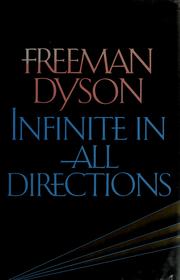
Infinite in All Directions Review
Freeman Dyson turns the Gifford Lectures into an expansive, questioning meditation on biological diversity, scientific ambition, technology, ethics, and humanity's cosmic future.
- Author
- Freeman J. Dyson
- First published
- 1988
View source
https://openlibrary.org/works/OL2007225WInfinite in All Directions review: a case for plurality
This Infinite in All Directions review finds Freeman J. Dyson at his most characteristic: intellectually restless, technically informed, ethically alert, and unwilling to let a single explanatory system close the discussion. The book grew from the 1985 Gifford Lectures at the University of Aberdeen. The official Gifford archive identifies the lecture series as In Praise of Diversity and describes its two-part movement from science and exploration to technology and ethics. That design supplies the book's real thesis. Diversity is not merely a biological fact for Dyson; it is a condition of discovery, resilience, freedom, and hope.
That thesis gives unity to a volume that ranges across the origin and future of life, the scale of the universe, weapons, engineering, and religion. The subjects can appear scattered when listed, yet Dyson repeatedly asks the same practical question: what happens when human beings mistake one successful way of understanding the world for the only possible way? His answer is that scientific and political health both depend on multiple scales, methods, communities, and ambitions.
Readers coming from UtoRead's science and nature collection will recognize the popular-science impulse, but this is not a survey of settled knowledge. It is an argument about the temperament with which knowledge should be pursued. Dyson values rigor, but he also values conjecture, invention, and dissent. The result is strongest when those values illuminate one another and weakest when imaginative possibility begins to stand in for probability.
From the cosmos to the local problem
The architecture of the book is one of expanding and contracting scale. Dyson looks outward toward the long future of life and inward toward the processes that make life varied. He then returns to immediate human problems: how technologies are chosen, who controls them, and what moral judgments scientific facts cannot make on their own. This alternation prevents the cosmic material from becoming pure spectacle. A vision of life spreading beyond Earth matters because it reframes responsibility on Earth, while an argument about a particular technology matters because local choices accumulate into a future.
The published edition is documented by Open Library as a 1988 book by Freeman J. Dyson, derived from the Aberdeen lectures. The Institute for Advanced Study's book list likewise records its 1988 publication and its origin in the Gifford Lectures given at Aberdeen in 1985. That provenance explains why the book does not behave like a conventional physics title. It does not proceed from a narrow problem through evidence to a bounded conclusion. Instead, it tests the implications of scientific ideas against questions of value, purpose, and human destiny.
This method makes the book unusually hospitable to non-specialists. A reader does not need advanced mathematics to follow the central line because the burden falls on distinctions and examples rather than formal derivations. Yet accessibility should not be confused with simplicity. Dyson continually changes scale, and the reader must decide when an analogy clarifies a problem and when it merely makes two distant problems look alike.
Diversity as the governing idea
Dyson's praise of diversity works on several levels. In biology, variety gives life room to adapt and develop. In intellectual culture, competing approaches protect inquiry from premature closure. In politics and technology, dispersed experimentation may produce forms of progress that a centralized program cannot anticipate. The attraction of this argument is not just that diversity sounds generous. Dyson treats it as a source of new information: differences create possibilities that uniform systems erase.
This is where the book's breadth becomes an asset. A narrower work might defend biological diversity, institutional pluralism, or exploratory science separately. Dyson places them in conversation, inviting the reader to see a recurring pattern without claiming that each domain operates by identical rules. His best transitions preserve that distinction. They offer resemblance as a tool for thought, not as proof.
The danger is that “diversity” can become too elastic a good. Variety alone does not tell us which experiments are responsible, which institutions are just, or which risks are acceptable. Dyson knows that technology creates victims as well as options, but his preference for openness sometimes leaves the criteria for choosing under pressure less developed than the case for keeping possibilities alive. Readers interested in that philosophical tension can continue through UtoRead's philosophy and psychology collection, where questions about knowledge and value receive more systematic treatment.
The persuasive power of an essayistic scientist
Dyson writes as a scientist who is comfortable showing the provisional character of his thought. The voice does not imitate a textbook's impersonality. It advances claims, follows surprising connections, and accepts that a worthwhile conjecture may remain vulnerable. That quality makes the book conversational even when its scale is immense. The reader encounters a mind trying out a structure rather than an institution delivering a verdict.
The style also helps explain why the volume can survive the aging of some examples. A forecast offered as dogma becomes an embarrassment when events move elsewhere. A forecast offered as a disciplined imaginative exercise can remain revealing even when it misses. Dyson's speculations expose the values behind his expectations: he prefers small-scale invention to bureaucratic monument, biological richness to engineered sameness, and open futures to declarations that the fundamental work of science is almost finished.
Still, the essayistic form has costs. Assertions arrive at different levels of support, and the graceful movement between them can conceal the shift. An observation about scientific practice, a moral preference, and a conjecture about the remote future may occupy neighboring paragraphs without carrying equal evidentiary weight. The alert reader must perform some classification that the prose does not always perform on the page. This is not a reason to distrust the book; it is the kind of participation the book demands.
Technology under ethical pressure
The second major movement turns from understanding nature to acting within it. Dyson's subjects include the destructive reach of nuclear technology and the transformative promise and danger of biological engineering. Because the lectures were delivered during the late Cold War, their immediate pressures belong to a recognizable historical moment. The enduring question, however, is broader: scientific capacity does not contain its own instructions for use.
Dyson is persuasive when he refuses the comforting division between pure knowledge and someone else's consequences. The scientist, engineer, policymaker, and citizen occupy different roles, but none can pretend that a technically possible project is therefore a worthy one. At the same time, he resists the opposite temptation to treat the suppression of inquiry as a complete ethical program. Knowledge produces risk, but ignorance is not neutral and institutions that promise safety can concentrate power.
This balancing act is valuable because it allows neither technological enthusiasm nor technological fear to end the argument. The weakness is practical specificity. A defense of freedom and diversity does not by itself decide how to regulate a dangerous experiment, distribute a benefit, or compensate those who bear risk without consent. The book offers a moral orientation more often than an administrative design. That makes it well suited to the history and ideas collection: its contribution is a way to frame public choices, not a policy manual ready for adoption.
Natural theology without a forced truce
The Gifford setting matters. These lectures traditionally provide room to examine religion in relation to reason and nature, and Dyson uses that room without trying to convert science into theology or theology into an obsolete science. His interest lies in purpose, mind, and the possibility that a universe hospitable to continuing novelty may carry meanings not exhausted by physical description.
This part of the book will divide readers more sharply than the defense of pluralism. Dyson is willing to let intuition and hope guide speculation beyond what observation can settle. For sympathetic readers, that candor is preferable to disguising metaphysical commitments as scientific results. For skeptical readers, the same passages may appear to grant cosmic significance to preferences that remain personal. The important critical point is that the book's religious thought is exploratory rather than doctrinal. It asks what kind of universe Dyson hopes science will continue to reveal.
The refusal to force a truce between science and religion is more interesting than a tidy reconciliation would have been. Science describes processes and tests models; ethical and religious traditions ask how lives should be directed and what ultimate significance, if any, those processes possess. The boundary is porous in Dyson's imagination but not erased. His willingness to inhabit the uncertainty gives the book warmth, though it does not turn hope into evidence.
What has aged, and what has not
More than three decades separate the book's publication from the present, and some of its urgency carries the texture of 1985: superpower confrontation, nuclear strategy, and expectations about the direction of biotechnology. Readers seeking a current guide to any of those subjects will need newer evidence. The book should not be treated as an update on contemporary physics, genetics, climate policy, or arms control.
The durable material is methodological. Dyson's suspicion of giant, centralized projects remains a useful provocation, especially when large institutions claim that scale guarantees rationality. His insistence that invention deserves intellectual respect alongside theoretical discovery still corrects a common hierarchy. Most of all, the defense of diversity remains a strong challenge to narratives that equate scientific progress with convergence upon one method, one institution, or one final picture.
Yet time also sharpens a caution already present in the text. Decentralized experimentation can distribute creativity, but it can also distribute harms faster than public institutions can recognize them. Diversity can resist monopoly, but it does not automatically produce equity. Reading Dyson now therefore works best as a dialogue. His principles identify what centralized control may destroy; contemporary experience asks what uncoordinated power may destroy in return.
Ideal readers and likely frustrations
The ideal reader enjoys ideas that cross disciplinary borders and does not require every chapter to settle a question. Students of popular science will find an example of explanation used in service of philosophical inquiry. Readers concerned with technology will find a scientist taking moral consequences seriously without retreating into simple prohibition. Discussion groups can use the book particularly well because its claims invite disagreement at identifiable pressure points: diversity versus coordination, imagination versus evidence, and freedom versus precaution.
Readers looking for a systematic introduction to cosmology or biology should begin elsewhere. The same applies to anyone seeking a neutral history of late-Cold-War science policy. Dyson is a participant with strong preferences, not a surveyor pretending to stand nowhere. His range can also feel discontinuous. A reader who wants one thesis demonstrated cumulatively may find the lecture sequence more associative than conclusive.
It helps to read slowly and mark the status of each claim. Is Dyson describing a verified process, drawing an analogy, making a moral judgment, or imagining a possible future? The book becomes clearer when those modes are separated, and more rewarding when they are later brought back together. Our editorial policy emphasizes the same distinction between sourced fact and critical interpretation; this review treats Dyson's speculative reach as an object of analysis, not as confirmed prediction.
Alternatives and final verdict
Readers who want a more concentrated account of cosmology may prefer A Brief History of Time. Those who want a grand public narrative in which scientific explanation and human significance are carried by a more deliberately lyrical structure may choose Cosmos. For a personality-driven account of scientific practice, experiment, and irreverent problem solving, Surely You're Joking, Mr. Feynman! offers a more autobiographical alternative. Dyson's book is the better choice when the desired subject is the traffic between fields: not physics alone, but physics beside biology, ethics, politics, invention, and religious imagination.
The final verdict is strongly positive but qualified. Infinite in All Directions is not timeless because every example remains current or every speculation has proved sound. It is durable because it models a form of thinking that keeps wonder under ethical pressure and keeps ethics open to the disruptive force of discovery. Dyson's central defense of diversity gives the book coherence without making it uniform, an apt formal match between argument and construction.
Its greatest strength is also its central risk. The freedom to range produces insights a more disciplined structure might never reach, but it can encourage the reader to accept a compelling possibility before asking how well it is supported. Read as an invitation to argument rather than a finished worldview, the book remains stimulating, humane, and productively unsettled.


