Book review
Naked Empire Review
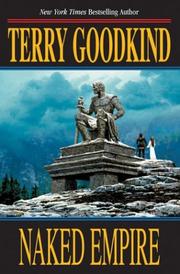
This Naked Empire review assesses Terry Goodkind's eighth Sword of Truth novel as a high-stakes continuation in which Richard's poisoning turns a rescue mission into an extended argument about force, freedom, and pacifism.
- Author
- Terry Goodkind
- First published
- 2003
View source
https://openlibrary.org/works/OL2010464WNaked Empire review: an antidote priced in moral obedience
This Naked Empire review begins with the coercive bargain at the center of Terry Goodkind's eighth Sword of Truth novel. Richard Rahl has been poisoned, and the antidote is withheld to force his intervention on behalf of a people facing destruction. His private need to survive becomes entangled with an empire-wide conflict, while Kahlan's safety is turned into another instrument of pressure. The structure ensures that every delay carries bodily and political cost.
Published in 2003, Naked Empire is not a neutral sample of epic fantasy. It arrives after seven substantial volumes of relationships, wars, magical rules, institutions, and philosophical conflict. The publisher identifies it explicitly as book eight and emphasizes the return to Richard and Kahlan. That is the correct reading frame. Newcomers may understand the immediate danger, but they will not feel the accumulated meaning of the choices.
The book's defining feature is argumentative intensity. Goodkind uses a threatened society committed to nonviolence to ask whether refusing force remains moral when aggressors exploit that refusal. Richard does not merely fight enemies; he attempts to persuade people that defending life and freedom can be an ethical obligation. Readers who welcome fantasy as a platform for explicit political philosophy may find the directness energizing. Readers who want ideas to emerge through ambiguity will likely find it overdetermined.
Book eight and the burden of continuity
Epic series create two kinds of scale. One is geographical and military: nations, armies, journeys, and magical threats. The other is mnemonic: a reader's memory of earlier promises, losses, identities, and rules. Naked Empire depends on both. Richard and Kahlan arrive with established authority and emotional history; the larger war is already in motion; antagonistic power is not invented for this installment.
This continuity gives the novel efficiency with loyal readers. It can place Richard in peril without rebuilding his importance from the ground up. Kahlan's threatened bondage carries weight because readers know her identity and relationship. Political positions have consequences accumulated across volumes.
The same strength creates the largest barrier. Starting here means receiving moral conclusions before experiencing much of the narrative history used to support them. Readers interested in the series should begin with Wizard's First Rule. That first novel establishes Richard's entry into the wider world and the foundational relationships that book eight treats as given.
Poison as a narrative clock
Richard's poisoning supplies a clear and effective deadline. Epic fantasy can become diffuse when travel, war, lore, and side plots compete. A deteriorating body gives every episode a common measure: time is being spent from a finite reserve. The hero who usually exercises unusual power must act while physically compromised and dependent on people whose demands he rejects.
The poison also embodies coercion. Richard is asked to make a moral and political commitment, but the request is backed by control over his life. This contradiction sharpens the book's debate about freedom. Can a cause be just when its advocates deny the chosen defender meaningful consent? Does desperate need excuse manipulation? Goodkind's sympathies are clear, yet the situation generates more tension than a voluntary quest would.
Kahlan's exposure to danger intensifies the bargain. The threat is not only that Richard will die but that saving himself may require accepting a path that places the person he loves under enemy power. The novel repeatedly converts ideals into decisions with bodies attached to them.
Pacifism under invasion
The society Richard encounters has organized its identity around a rejection of violence. That commitment initially appears principled, especially within a series world saturated by war and domination. Goodkind's challenge is to place nonviolence before an enemy that treats restraint as an opportunity. The question becomes whether refusing to resist protects moral purity at the expense of victims.
Richard's answer is forceful: life and liberty may require active defense. The novel distinguishes aggression from resistance and argues that moral judgment cannot ignore who initiated coercion. This position gives the book a clear thesis and explains why persuasion occupies so much space.
The limitation is that the debate rarely feels balanced. Pacifist arguments are often arranged to be defeated, while Richard speaks with the authority of protagonist, experience, and plot outcome. Readers who share his premise may appreciate the clarity. Others may want stronger engagement with traditions of nonviolent resistance, collective action, or the risk that defensive violence reproduces what it opposes. The novel stages a case, not an open seminar.
Richard and the rhetoric of leadership
Richard's role combines warrior, ruler, teacher, and moral advocate. He must not only defeat immediate threats but transform how a people understand themselves. Goodkind presents leadership as the ability to name a suppressed truth and make others capable of acting on it.
This can be stirring. A fantasy hero who helps people claim agency offers a different pleasure from one who simply rescues passive victims. Richard's physical weakness also prevents leadership from being reduced entirely to superior combat. Words, example, and strategic judgment matter.
Yet the teaching relationship is unequal. The newcomers' culture is judged largely through Richard's framework, and their growth is measured by movement toward his conclusions. Readers sensitive to savior narratives may find the pattern troubling. The novel wants liberation, but its route to liberation centers an exceptional outsider who explains necessity to an entire society.
Kahlan, peril, and the emotional stakes
The publisher's description places Richard and Kahlan at the center, and their bond gives the sprawling conflict an emotional line. Kahlan is not merely an abstract reason for Richard to act; she carries political identity, experience, and capacity built across the series. Her danger matters because she is a central figure rather than a newly introduced hostage.
At the same time, the threat of delivering her into bondage uses violence against a woman to intensify a male protagonist's dilemma. Long-running readers can place that device within Kahlan's broader agency, but the pattern remains worth criticizing. High stakes do not automatically justify every form of threatened harm.
Goodkind's world often treats bodily violation and domination as evidence of evil. That directness leaves little uncertainty about antagonists, yet repeated exposure can become exhausting. Readers should expect coercion and threats of sexual violence alongside battle and torture, not a sanitized quest.
Action, speech, and pacing
The novel alternates urgent movement with extended argument. The poison and invasion promise acceleration, while debates about force and moral responsibility slow the narrative to articulate its thesis. Whether this feels substantial or repetitive will determine much of a reader's response.
Goodkind's admirers often value the refusal to hide conviction behind atmospheric worldbuilding. Ideas are spoken because characters believe speech can change action. Critics may feel that characters become vehicles for positions already settled by the author. Both responses identify the same formal fact: Naked Empire wants its adventure to persuade.
The length magnifies this effect. At epic scale, repetition can function as reinforcement, ensuring that a political transformation feels earned across many encounters. It can also make the novel feel less confident in the reader's ability to infer. The best fit is someone who wants direct thematic pressure as part of the genre contract.
Strengths within the Sword of Truth series
The first strength is a strong central engine. Poison, an antidote, invasion, and Kahlan's danger pull the plot toward difficult choices. The stakes are legible even when the series history is complex.
The second strength is the connection between personal survival and collective agency. Richard cannot solve his problem without confronting what a threatened people believe about resistance. Conversely, their crisis cannot be resolved merely by his private heroism. The design aims to join individual ethics to political consequence.
The third strength is the renewed focus on the central couple. Readers continuing from a volume that shifted attention elsewhere may welcome Richard and Kahlan's return. Those planning to proceed can compare this installment with Chainfire, where the series again tests their bond through a different disruption.
Cautions and reader fit
This novel is for committed epic-fantasy readers, especially those already comfortable with Goodkind's ideological directness. It suits readers who enjoy large conflicts, protagonists with firm moral positions, and arguments about freedom woven into violent adventure. It is emphatically adult fantasy, not young-adult fiction.
Readers should avoid it if they want a stand-alone story, subtle political ambiguity, economical prose, or low levels of brutality. Coercion, enslavement, graphic conflict, and threats of sexual violence are integral to the stakes. The book also asks patience with speeches that restate and sharpen its moral case.
Within the fantasy collection, its closest useful comparisons are long-form works where worldbuilding carries a philosophy of power. Readers looking for a gentler or more mythic mode should choose another title. Those interested in ideas as such can use the history and ideas route, but they should remember that the novel dramatizes a strongly partial argument rather than offering balanced political analysis.
Final assessment
Naked Empire converts Richard's poisoned body into a clock for an ideological epic. The price of survival is action on behalf of others, but the demand itself violates the freedom the novel prizes. That contradiction gives the adventure genuine pressure even when Goodkind's final moral conclusions are unmistakable.
The book will not persuade readers who resist the series' rhetoric, violence, or exceptional hero. For established readers, however, it offers a substantial return to Richard and Kahlan and a clear thematic conflict: whether the refusal to resist evil can become complicity in the harm done to others. Its strengths and limitations arise from the same source—an absolute determination to make fantasy declare what it believes.


