Book review
Novelle per un anno Review
This Novelle per un anno review argues that Pirandello's short-story cycle matters for readers who want Italian literature shaped by irony, social pressure, and unstable identity.
- Author
- Luigi Pirandello
- First published
- 1900
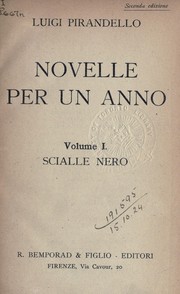
View source
https://openlibrary.org/works/OL15699928WNovelle per un anno review: Pirandello's argument with ordinary life
Novelle per un anno review: Pirandello's collection is best approached as serious Italian short fiction, not as a book that tries to flatter the reader or smooth every transition into comfort. What it offers instead is a sustained study of irony, social pressure, and unstable identity, written in a mode that keeps everyday life slightly off-balance. The result is a book that asks readers to notice how quickly a person can become a role, a mask, an excuse, or a target.
That is why the collection matters in a catalog like Online Library. A review should not merely confirm that a classic exists; it should help a reader decide what kind of experience the book is likely to produce. Pirandello's Novelle per un anno is important because it rewards readers who like literary precision, but it also makes a strong case for fiction that can be observant without becoming warm, elegant without becoming easy, and humane without pretending that social life is gentle.
In that sense, the book has a clear thesis of its own: ordinary life is never as simple as it pretends to be, and the pressure to behave normally can be just as revealing as any dramatic crisis. That is a durable literary problem, which is why Novelle per un anno still belongs in a serious reading map.
Reader fit and likely response
Novelle per un anno will work best for readers who enjoy Italian literature, short fiction, and books that value psychological tension over overt plot machinery. If a reader wants the sort of narrative that moves in a straight line, resolves itself quickly, and keeps its emotional cards on the table, this is probably not the right first stop. The collection is more interested in pressure, repetition, reversal, and the weird dignity people can display while trying to survive public life.
Readers who like fiction to test assumptions, however, may find it unusually satisfying. Pirandello often makes a scene feel like a social experiment: a small shift in status, a change in who is watching, or a sudden awareness of how others interpret a gesture can alter the entire meaning of what is happening. That is one reason the work still reads like a living piece of literature rather than a museum object.
The collection is also a good fit for readers who are willing to read with patience. It does not always reward speed, because part of the pleasure is in hearing how a situation turns, how a tone hardens, or how irony arrives just as certainty seems to settle. In that respect, Novelle per un anno belongs with books that ask to be interpreted rather than simply consumed.
Readers should also expect emotional complexity rather than emotional comfort. Pirandello can be funny, sharp, and unsparing in the same paragraph. He is rarely sentimental about human weakness, but he is also not indifferent to it. The book's intelligence comes from refusing easy moral simplification.
That combination makes the collection especially useful for readers who are building a broader reading habit. It can sharpen expectations for other literary short-story collections, and it can make a later novel or memoir feel more transparent by comparison. For readers browsing History and Ideas Reviews, that larger habit of comparison is part of the appeal.
Strengths: irony, structure, and social pressure
The most obvious strength of Novelle per un anno is Pirandello's control of irony. This is not irony as a decorative flourish or a clever wink at the reader. It is a method for showing how social life operates. People misunderstand one another because they must perform; they perform because they fear what others will think; and what others think often becomes more powerful than private truth. Pirandello keeps returning to that pressure until it starts to feel structural.
Another strength is the collection's sense of form. Even when the stories vary in tone, they share a disciplined attention to movement. Pirandello understands that a story can become sharper when it resists obvious closure. Instead of rushing toward a large emotional payoff, he often lets the reader sit inside a disturbance long enough to see its shape. That patience gives the work a durable aftertaste.
Social pressure is where these qualities meet. In many writers, social pressure is treated as background atmosphere. In Pirandello, it becomes active force. He shows how etiquette, class position, family obligation, reputation, and self-protection can squeeze a person into conduct that looks rational from the outside but feels brittle from within. That is one reason the book still feels modern: it understands identity as something negotiated under observation.
There is also a genuine intelligence in how the collection handles instability. Where other writers might use madness, breakdown, or violence as shock material, Pirandello is often more interested in the conditions that make those states imaginable. The effect is less sensational than diagnostic. He wants to show how thin the line can be between ordinary social performance and psychic fracture.
That restraint matters. It keeps the book from becoming melodrama, even when the situations are severe. The collection trusts the reader to notice how irony, embarrassment, self-deception, and social humiliation can carry real force without being turned into spectacle. For many readers, that is the book's deepest strength.
Novelle per un anno also has route value. Placed beside Ring of Bright Water, America, or a Child Called It, the book helps readers feel how different authors organize pressure, sympathy, and narrative control. Those are not genre twins, but they are useful comparison points because they make the reader ask what sort of tension a book is trying to sustain.
Cautions: density, repetition, and emotional distance
The main caution with Novelle per un anno is that the collection can feel demanding if a reader wants a single immersive arc. Short fiction invites concentration, but it also asks the reader to reset repeatedly, and that can make the book feel modular rather than sweeping. For some readers, that structure is a feature; for others, it will feel like friction.
There is also a certain emotional temperature to Pirandello's method. He is rarely cold in the sense of being empty, but he can be cool, exact, and unsentimental in a way that leaves little room for the kind of open-handed reassurance some readers want from classic literature. If you prefer fiction that quickly offers comfort, affirmation, or neatly resolved feeling, this collection may feel withholding.
That same quality also affects how the book handles more extreme material. When the stories edge toward coercion, humiliation, breakdown, or violence, Pirandello does not usually turn the volume up for its own sake. He keeps the focus on social and psychological implication, which is artistically effective but can also create distance. Readers who need stronger emotional access may need to adjust their expectations.
Another limit is that the book rewards literary patience more than quick summary. Its significance does not always reside in a single climactic twist. Instead, it accumulates through tone, pattern, and pressure. That means a rushed reading can flatten the experience and make the collection seem more repetitive than it really is.
None of these cautions are reasons to avoid the book. They are reasons to enter it with a clear sense of what it is doing. A reader who expects a polished social portrait, precise psychological observation, and recurring irony will be in a far better position than one who wants immediacy alone.
Context: Italian literature and Pirandello's reach
Novelle per un anno belongs to a major tradition in Italian literature, and that context matters. Pirandello is not simply telling stories in a vacuum; he is working inside a literary culture that has long cared about form, performance, contradiction, and the unstable relation between outward appearance and inward truth. His fiction is one of the places where those concerns become especially vivid.
That is also why the book feels more intellectually useful than a brief label can suggest. It is not only "a collection of stories." It is a way of thinking about how people survive in public, how they misread themselves, and how society turns ordinary gestures into moral facts. Pirandello's attention to masks, self-division, and the performance of identity gives the book a strong place in the wider history of modern literature.
Seen that way, the collection also strengthens the History and Ideas Reviews shelf by giving it a literary counterpart to books that are more explicitly argumentative or documentary. A good catalog does not force every title into one lane; it lets readers move from one kind of thinking to another.
There is a practical value in that movement. Readers who come to Pirandello through social history, modern Italian writing, or the psychology of role-playing can leave with a sharper sense of how literature handles those subjects without ever reducing them to theory. That makes Novelle per un anno useful not only for enthusiasts of Italian classics but also for readers trying to understand how fiction can observe the structures that shape a life.
Alternatives and comparison routes
Because Novelle per un anno is a demanding literary collection, comparison routes matter. A reader who enjoys its irony and precision may want to move toward other books that reward close attention without promising easy comfort. A reader who finds its reserve too cool may want something more openly emotional or more visibly plot-driven.
That is where the surrounding catalog becomes useful. Ring of Bright Water offers a very different emotional register, but it also rewards readers who notice the relationship between observation and feeling. America gives another route into books that organize experience through perspective and pressure. a Child Called It is a harsher comparison in content and tone, but it helps sharpen the question of how a book handles suffering without collapsing into sentimentality.
Those comparisons are not meant to flatten differences. They are meant to help readers see what Pirandello is doing by contrast. Novelle per un anno is quieter than some books and more unsettling than others. It does not offer easy uplift, but it does offer a disciplined literary intelligence that can make other reading choices clearer afterward.
For readers who want a broader route, the most useful next step is simply to keep moving between the History and Ideas Reviews shelf and adjacent literary fiction. That approach turns Novelle per un anno into a bridge rather than a dead end.
Final assessment
Novelle per un anno deserves a place in a serious review library because it shows how literary short fiction can expose the logic of social pressure without turning people into symbols. Pirandello is sharp about identity, status, and the small humiliations that make public life feel precarious, but he is never merely clinical. The collection keeps asking what it costs to live among other people and to remain legible to them.
That is why the book works best for readers who value irony, structural intelligence, and a certain moral seriousness that does not need to announce itself loudly. It may not be the easiest classic to enter, and it is not designed to reassure. But it is a rewarding book for anyone who wants Italian literature that thinks hard about selfhood, performance, and the fragile theater of everyday life.
It also earns its place by refusing to reduce that theater to a single lesson. The stories do not simply prove that people are contradictory; they show how contradiction becomes legible through tone, timing, and social consequence. That makes Novelle per un anno especially valuable for readers who care about how fiction works on the sentence and scene level, not just what it appears to be "about" at a glance. In a review catalog, that level of precision is what turns a classic into a useful recommendation.


