Book review
Tender Morsels Review
This Tender Morsels review reads Margo Lanagan's novel through identity formation, resilience, and narrative care after trauma and dislocation.
- Author
- Margo Lanagan
- First published
- 2008
View source
https://openlibrary.org/works/OL5708760WTender Morsels review: refuge, agency, and the danger of a painless world
This Tender Morsels review approaches Margo Lanagan's novel as a radical reworking of “Snow-White and Rose-Red” centered on Liga and her daughters, Branza and Urdda. The book begins with sexual violence, coercion, and despair; its fantasy grows from Liga's desperate need for safety. A protected world appears to offer the home denied to her, but Lanagan refuses to treat refuge as a permanent solution. Safety without risk can also suspend choice, knowledge, and the daughters' ability to enter lives not designed by their mother's fear.
The novel is demanding because its fairy-tale beauty never cancels its brutality. Lanagan's language can be lush, earthy, comic, and disturbing within a short span. Readers should not expect trauma to function as a brief origin story before uncomplicated healing. The book keeps asking who pays for protection and what agency means after harm.
Liga and the creation of the protected world
Liga's wish for escape is morally intelligible. She has been violated within a world that offers little protection or justice, and the haven she receives gives her daughters a childhood beyond the immediate reach of male violence. Lanagan takes that wish seriously. Domestic peace, growing bodies, food, work, and affection are not mocked as naive desires.
Yet the haven is constructed around Liga's need, not negotiated by Branza and Urdda. Its gentleness contains omissions. The daughters cannot understand danger they have never encountered, and Liga cannot prepare them for a wider world without admitting what the refuge has excluded. The novel therefore distinguishes healing space from complete life.
Liga is neither blamed for wanting safety nor idealized as a mother whose love automatically produces freedom. Her choices reveal the ethical complexity of parenting after trauma: protection can be care, fear, control, and survival at the same time.
Branza, Urdda, and two responses to containment
Branza and Urdda are not interchangeable fairy-tale sisters. Branza is more attached to the textures and emotional assurances of the protected world. Urdda is more restless, skeptical, and drawn toward what lies beyond it. Their divergence prevents the novel from offering one correct timetable for leaving safety.
Urdda's movement outward is not a simple triumph of courage. Curiosity exposes her to danger, confusion, and knowledge that cannot be returned to innocence. Branza's attachment is not merely timidity; she has genuine bonds to a place that nurtured her. Lanagan lets agency emerge differently in each daughter, a welcome resistance to narratives that measure recovery only by visible independence.
The sisters also expose the cost of secrecy. Liga's silence is understandable, but it limits the language available to them. Readers interested in young characters facing inherited violence may compare Children of Blood and Bone, while remembering that Lanagan's scale is domestic and fairy-tale rather than epic.
Bears, men, and the Snow-White-and-Rose-Red transformation
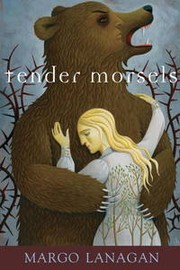
The bear material gives the novel its most visible relation to the source tale. Lanagan uses bear bodies, human desire, and movement between forms to complicate the original's domesticated wonder. The bears are not simply charming visitors awaiting release into princely identity. They carry appetite, tenderness, threat, and access between worlds.
This transformation unsettles a clean opposition between dangerous men and safe animals. The novel does not erase gendered violence, but it refuses to make nature innocent or humanity uniform. The bear figures create encounters through which Branza and Urdda develop distinct relations to desire and fear.
Readers who know “Snow-White and Rose-Red” will recognize sisters, bears, domestic shelter, and transformation, yet the novel's purpose is not faithful retelling. It asks what the old tale leaves unspoken about female safety, consent, and the price of the happy household.
Language, viewpoint, and tonal risk
Lanagan's prose is sensuous and materially attentive. Bodies, food, weather, labor, injury, and animal presence receive language that can be beautiful without becoming polite. Viewpoint moves among characters, widening the story beyond Liga's understanding. This allows readers to see how one person's refuge becomes another person's limit.
The tonal range is a strength and a difficulty. Humor or fairy-tale strangeness can appear near traumatic material. Some readers will experience this as a truthful refusal to let violence monopolize existence; others may find the shifts destabilizing. The novel does not provide a neutral clinical vocabulary for harm.
Its density also demands patience. Readers entering through fantasy should expect literary compression and symbolic recurrence rather than a rules-based magical system. Young adult classification can be misleading if taken as a promise of gentle content.
Agency after trauma and the limits of protection
The central argument is not that victims must abandon safety to become whole. It is that a world organized to prevent every recurrence of pain can deny other people the knowledge required for consent and self-direction. Liga's haven saves lives. It cannot decide those lives forever.
Lanagan is alert to the danger of turning recovery into a heroic test. Branza and Urdda do not owe identical forms of bravery, and Liga's fear is not conquered by one revelation. Change occurs through intrusion, relationship, error, and the gradual recognition that protection must be responsive rather than absolute.
The novel's limitation is that its symbolic machinery can obscure practical distinctions among kinds of violence and recovery. It is fairy-tale criticism, not a guide to trauma care. Readers should resist converting its transformations into universal claims.
Content cautions and suitable readers
The book includes incestuous abuse, sexual assault, coercion, pregnancy, self-harm, and continuing consequences of violence. These are foundational rather than incidental. A reader seeking a comforting retelling should choose another work. Carve the Mark or Watch the Skies offer different relations between danger and agency, though neither substitutes for Lanagan's specific project.
The best-fit reader appreciates feminist fairy-tale revision, complex maternal choices, and prose that treats the body with both beauty and unease. The novel is less suited to readers who need linear healing, stable tone, or a sharp boundary between adult and adolescent material.
Discussion should keep Liga, Branza, and Urdda distinct. Treating them as a single emblem of wounded femininity would repeat the loss of agency the novel examines.
The title's tenderness
The title is not ironic in a simple sense. Tenderness survives in meals, sisterly attachment, care for bodies, and the fragile effort to imagine relations not governed by abuse. “Morsels” also suggests division and appetite: vulnerable people can be consumed by systems or by readers seeking cathartic suffering. Lanagan resists that consumption by giving Liga, Branza, and Urdda desires that do not exist only to demonstrate trauma. Their ordinary preferences are part of the novel's moral claim.
Final assessment
Tender Morsels is powerful because it grants Liga's desire for a painless home and then investigates what that gift cannot provide. The protected world, the two daughters' divergent needs, and the transformed bear material turn “Snow-White and Rose-Red” into an argument about refuge without romanticizing exposure to harm.
Lanagan's style is uncompromising, and the novel's shifts between brutality, domestic detail, desire, and wonder will divide readers. Its symbolic form can be overextended, and its content requires deliberate consent from the reader. Still, it offers unusually serious criticism of the belief that love protects best by eliminating uncertainty. Safety matters; so do knowledge, relation, and the right of Branza and Urdda to become more than the answer to Liga's terror.


