Book review
The croquet player Review
This The croquet player review assesses H. G. Wells's 1936 science fiction novel as a compact, idea-led work for readers interested in speculative unease, historical context, and moral pressure.
- Author
- H. G. Wells
- First published
- 1936
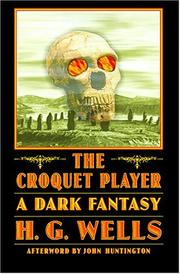
View source
https://openlibrary.org/works/OL52219WThe croquet player review: a complacent narrator catches another man's fear
This The croquet player review begins with an unnamed, self-satisfied English narrator whose devotion to croquet advertises his protected relation to the 1930s crisis around him. At a French hotel he listens to Dr Finchatton describe the terror he experienced in the invented fenland district of Cainsmarsh. Cruelty, ancestral imagery, and a haunting sense of prehistoric violence have overwhelmed the doctor until ordinary events feel charged by an older brutality.
Dr Norbert initially appears as Finchatton's psychotherapist and explains the Cainsmarsh story as a fable produced by trauma. Yet Norbert has absorbed the same fear. His “endemic panic” turns the case outward: the psychical infection is a response to contemporary violence, social breakdown, and the collapse of confidence in progress. The narrator tries to preserve his rational insensibility, but listening changes him. His growing irritability and unease show that testimony itself can transmit what clinical explanation cannot contain.
Wells's novella is therefore not a generic late-career warning about civilisation. Its form matters. One distressed man tells a story to another; a doctor reframes it; the comfortable listener becomes implicated. Croquet remains a comic emblem of insulated normality while historical dread presses through the surface. The imagined district is Cainsmarsh, the name used consistently in Wells's text.
What kind of science fiction is this?
Calling The croquet player a science fiction novel does not mean it must resemble space opera, hard science fiction, or contemporary speculative worldbuilding. Wells's science fiction often works through a different mechanism: a governing idea presses against social habits until the habits begin to look thin. In that tradition, the book's scientific or speculative dimension should be understood as a way of testing the civilized self, not merely as a source of devices or marvels.
That distinction matters for reader fit. Some science fiction builds outward through invented institutions, maps, technologies, and timelines. Other science fiction builds inward, turning one premise into a pressure chamber for fear, ethics, class assumptions, or historical anxiety. The croquet player appears much closer to the second mode. The title itself suggests manners, sport, leisure, and social ritual. Set beside Wells's reputation for speculative disturbance, that mild surface becomes interesting. The reader can expect a contrast between the composed world implied by croquet and the less stable forces Wells often brings into view.
This is also why the book sits naturally near both Science Fiction and Science And Nature. Wells's imagination repeatedly crosses those boundaries. He is rarely interested in science as a neutral collection of facts. He is interested in what scientific thinking does to the human picture: how biology, time, environment, technology, and collective behavior expose limits in human confidence. Even when a work is not dominated by laboratory detail, it can still belong to a science-and-nature comparison if it asks readers to think about humanity as a species under pressure.
A modern reader should therefore avoid imposing a narrow definition of the genre. The croquet player may not satisfy someone seeking dense technical explanation or cinematic action. It is more plausibly for readers who like speculative fiction when it becomes a diagnostic instrument. The book's value depends on atmosphere, argument, implication, and the tension between social form and disruptive knowledge.
Historical context without inflated certainty
The publication year, 1936, is not a decorative fact. A Wells novel from that date comes from a Europe living under visible political strain, after one world war and before another. Without making unsupported claims about the book's specific references, it is fair to say that interwar anxiety gives late Wells a charged backdrop. Science fiction in this period could not easily be innocent about progress. The nineteenth-century confidence that knowledge and invention would steadily improve human life had been damaged by mechanized war, political extremism, economic instability, and the recognition that modern systems could amplify violence as well as comfort.
The croquet player should be read with that pressure in mind. Wells's earlier fiction often dramatized the shock of scale: vast time, alien minds, evolutionary reversal, technological transformation, social engineering. By 1936, the shock of scale had become historical as well as imaginative. The future was not merely a playground for invention. It was a field of risk. A late Wellsian speculative novel can therefore feel less like a forecast than a warning about what already exists beneath public language and refined behavior.
This does not mean the book should be reduced to a period document. The danger with contextual reading is that it can make fiction seem like a footnote to history. The better approach is to let the date sharpen the questions. What does civilized conduct conceal? How stable are educated assumptions when fear enters the room? Can modern people explain their own impulses, or do they merely decorate them? How does a society describe itself when its confidence begins to fail? These are broad questions, but they are suited to Wells's intellectual temperament and to the supplied genre classification.
Readers who are drawn to later works of broken civilization may find a useful comparison in Riddley Walker. Russell Hoban's novel is not being treated here as the same kind of book; it belongs to a different moment and has its own linguistic and cultural project. The connection is broader: both invite readers to think about what remains when the confident structures of civilization are damaged or exposed. Wells's route is earlier and more compressed, but the concern with cultural fragility belongs to a larger speculative tradition.
Strengths: compression, contrast, and moral pressure
The first strength of The croquet player is likely its compression. Short or compact speculative fiction can be especially effective when it does not try to simulate an entire world. Instead, it isolates an anxiety and sharpens it. Wells's reputation suggests that he understood how to make an idea carry narrative force. In a book like this, the power may come from the gap between surface calm and deeper disturbance. The title's social mildness becomes a frame for unease.
The second strength is contrast. Croquet evokes rules, lawns, leisure, measured competition, and social order. Science fiction, in Wells's hands, often introduces forces that humiliate such order: time, instinct, biology, invasion, historical movement, or technological consequence. Even without asserting specific plot events, the pairing of title, author, date, and genre indicates a work built around tension between civilized surfaces and disruptive knowledge. That tension remains one of speculative fiction's most reliable tools because it does not require extravagance. A quiet setting can become alarming when the assumptions supporting it start to weaken.
The third strength is Wells's usefulness as a writer of questions. His fiction is not always subtle in the modern literary sense, and readers who want ambiguity above all else may find his argumentative habits too visible. But those habits can be a virtue. Wells pushes fiction toward public thought. He wants speculation to matter beyond the cleverness of the premise. A book like The croquet player is valuable if it makes the reader consider whether comfort has been mistaken for stability.
The fourth strength is its late position in Wells's career. For someone exploring early science fiction, this book can complicate the idea that Wells belongs only to the genre's origin story. A 1936 title shows him in a later phase, when the consequences of modernity had become harder to treat as abstract possibilities. That makes the book potentially useful for readers who want to see science fiction not as a single mode but as a changing conversation across decades.
Cautions: pace, expectation, and genre distance
The most important caution is expectation. Readers who come to Wells through his most famous speculative premises may expect a large conceptual hook announced with immediate force. The croquet player may require a different patience. Its likely rewards are not necessarily in breadth of invention but in tonal and intellectual pressure. That can be satisfying, but only if the reader is prepared for a book that may feel more like a disturbing conversation with modern civilization than a conventional genre ride.
A second caution concerns pace. Late or idea-led speculative fiction often moves according to argument as much as event. That does not make it weak, but it changes the kind of attention required. Readers looking for rapid incident, elaborate action, or a plot that constantly escalates may be better served elsewhere. Readers who enjoy a premise unfolding through implication, mood, and debate are more likely to find value here.
A third caution is historical distance. Wells's prose, assumptions, and intellectual habits belong to his period. The book should not be approached as if it were written under contemporary genre conventions. Modern science fiction often expects deeper character interiority, more complex social representation, or denser systems of worldbuilding. Wells may instead foreground diagnosis, thesis, and symbolic arrangement. That can feel bracing or stiff depending on the reader.
A fourth caution is that the book's brevity or compactness, if encountered in that form, should not be confused with slightness. Some readers equate major works with scale. Wells often proves that a speculative idea can be brief and still severe. But readers who want immersion above all else may find that severity too narrow. The best reader for this book is not asking to live inside a fictional world for hundreds of pages. The best reader is willing to sit with a controlled disturbance.
For a lighter speculative route, My Teacher Glows In The Dark may serve a very different audience. That comparison is useful because it clarifies fit: not every science-fiction reader wants the same pressure. Some want comic or accessible strangeness; others want historical unease and intellectual friction. The croquet player belongs closer to the latter group.
How it fits within H. G. Wells's reputation
An H. G. Wells review inevitably carries the weight of the author's larger reputation. That can help and hurt. It helps because readers know to expect fiction shaped by speculative intelligence. It hurts because the famous titles can overshadow smaller or later works. The croquet player should not have to compete directly with the cultural magnitude of Wells's best-known novels. A fairer standard asks what this specific book contributes to the Wellsian pattern.
That contribution appears to be a late refinement of unease. Wells's recurring interest in the instability of human arrangements remains relevant because modern readers still live among systems that look orderly until pressure reveals their weaknesses. His work often challenges the fantasy that civilization is a permanent achievement. The croquet player, by title alone, places a symbol of civilized leisure at the center of attention. In a Wells context, such a symbol is unlikely to remain merely decorative.
The book also reminds readers that science fiction is not only about future hardware. It can be about the present seen under an altered light. A speculative premise can make a drawing room, a game, a conversation, or a social habit feel newly precarious. That is one of Wells's lasting gifts to the genre. He helped establish the idea that fiction could use scientific and speculative thinking to change the moral temperature of everyday life.
Readers comparing Wells with later screen-centered speculative storytelling might consider Star Wars Episode V The Empire Strikes Back as a deliberately distant contrast. That work represents a mythic, cinematic mode of science fiction and fantasy adventure. Wells's mode is more essayistic, more socially anxious, and less dependent on spectacle. The contrast helps define The croquet player by what it is not: not a space adventure, not a heroic saga, not a franchise episode, but a compact speculative provocation.
Reader fit and final assessment
The croquet player is best for readers who want science fiction to unsettle categories rather than decorate them. It is suited to readers who appreciate older prose, historical context, and fiction that argues through structure and atmosphere. It may also interest readers studying how speculative writing responded to the crisis of modern confidence in the early twentieth century. The book's appeal is likely strongest when approached as a late Wells work concerned with fear, order, and the limits of civilized self-description.
It is less ideal for readers who want plot abundance, deep immersion in invented worlds, or contemporary genre pacing. Nothing in the supplied metadata justifies selling it as an action-heavy novel or as a sweeping future history. A responsible recommendation should keep the promise narrower and more honest. The appeal lies in Wells's ability to use speculative fiction as a lens on human instability.
As a review subject, The croquet player remains worthwhile because it challenges the assumption that minor or less-discussed works by major authors are only of archival interest. Some books matter because they are central monuments. Others matter because they reveal a writer's recurring concerns under different historical pressure. This appears to be the second kind. It can help readers see Wells not merely as an inventor of famous premises but as a writer persistently worried about the fragility of order.
The final verdict is therefore qualified but favorable. The croquet player is not the obvious first Wells recommendation for every reader, and it should not be packaged as more expansive than it is. Yet for readers interested in science fiction as moral inquiry, the book offers a serious route into late Wells. Its promise is not comfort, scale, or spectacle. Its promise is disturbance: the sense that beneath a composed social surface, older fears and future dangers are already present.


