Book review
The Human Use of Human Beings Review
This The Human Use of Human Beings review considers Norbert Wiener's science or nature book through reader fit, strengths, cautions, context, and related books.
- Author
- Norbert Wiener
- First published
- 1950
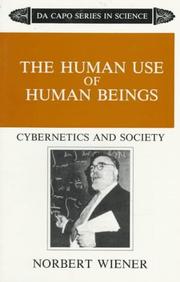
View source
https://openlibrary.org/works/OL4307570WThe Human Use of Human Beings review: cybernetics as a mirror for responsibility
This The Human Use of Human Beings review exists because Norbert Wiener's argument still does not feel dated. In 1950, Wiener asked how technical systems alter human judgment, social organization, and moral imagination. In a catalog where technical writing often arrives as trend commentary, this title is one of the few that treats machinery, institutions, and people as part of one continuous system. The Human Use of Human Beings sits naturally in the science and nature category, yet its best value appears in the way it travels into history and ideas every time a reader compares it with policy debates, classroom arguments, and media narratives about control.
The thesis here is direct: this book earns a place in a serious reading collection because it does not ask readers to accept technical progress as neutral. It asks them to examine who benefits, who is excluded, and who is trained by the systems they use every day. That is why this title sits well as a review that influences later decisions rather than a checklist answer for a single mood.
What this book is building
The first move in The Human Use of Human Beings is to define communication and control not as purely mechanical events but as social habits. Wiener presents feedback as a principle that connects nerves, machines, institutions, and governance. The argument is not always presented as a neat system diagram, yet its implication is clear: when a mechanism can measure and correct, it can also reshape behavior.
The prose in The Human Use of Human Beings carries an unusual density for a general audience text. Many passages read like civic thought experiments, then loop back into practical questions. This back-and-forth can feel demanding, especially when the reader expects a narrative essay. The demand is deliberate. If a book about scientific method asks for speed, the reader may miss how its concepts distribute responsibility across actors who claim certainty from numbers alone.
The strongest contribution of The Human Use of Human Beings is to frame human values as part of system design. Technology is not treated as external machinery, but as something already entangled with ethics, labor, and institutions. That framing keeps the review meaningful even for readers who are not specialists in engineering or mathematics. It is a text about attention: what humans choose to measure, and what falls out of that attention.
Who should read this and who may pause
The Human Use of Human Beings suits readers who want nonfiction with conceptual gravity and do not need a quick dopamine hit before bedtime. It is especially useful for readers moving between technical and cultural reading habits, because the book does not let those habits stay separate. A reader used to technical writing may find the historical and philosophical asides unusual; a reader used to essay collections may find the terminology patient and precise.
It is less suitable for readers seeking a compact handbook or a practical implementation guide, and less suited for those who want only one moral in, one takeaway out. The structure moves by tension rather than by recipe. A careful reader will still find clear value: the book is better at widening the question-space than delivering final certainty.
The Human Use of Human Beings may challenge readers who expect modern technological terms everywhere, because much of its vocabulary comes from an earlier era. That tension can become a benefit for a reader who wants to compare current debates with their intellectual ancestors.
Strengths in a modern catalog
The first strength is historical anchoring. The Human Use of Human Beings introduces cybernetics not as a niche discipline but as a framework that still helps explain social media dynamics, workplace monitoring, and algorithmically mediated routines.
The second strength is moral specificity. Wiener does not retreat into abstract warnings; he repeatedly ties feedback to consequences. The book's strongest moments occur when it asks what happens when systems optimize for measurable outputs and forget context. That is directly relevant when readers use review routes to evaluate books around governance, labor, and science.
The third strength is structural durability. The Human Use of Human Beings is short enough to revisit without losing orientation. It can be reread at different life stages and return different questions: first around invention, later around control, then around institutional design.
This review gains route value from the way it connects to other parts of the collection: Essential Cell Biology brings a different method of making biological systems legible, Fragments of Science broadens comparative method, and pe Civil Exam Review Guide shows how conceptual density can be translated into learning pathways.
Cautions and blind spots
Some readers will find the book uneven because the strongest chapters can appear in rapid alternation with denser passages. The Human Use of Human Beings asks for patience with transitions from conceptual framing to concrete social implications. The reward is substantial, but the pacing can reward slower reading.
The book also reflects the language and institutional assumptions of its historical moment. Those assumptions are not fatal, but they require active comparison. A reader should hold the text beside later developments in digital ethics, data governance, and public policy studies to get the full picture.
Another caution is emotional distance. This is not a narrative that seeks intimacy. It does not foreground personal story, and readers who need affective immediacy may reach less satisfaction than from character-driven works. In that sense, its route value depends on a clearly defined reader fit.
Context and alternatives
In the Online Library catalog, The Human Use of Human Beings behaves as an entry-point title for wider questions about agency, institutions, and public language. It performs best when treated as part of a route rather than a final word. The Human Use of Human Beings gives readers language for evaluating texts that discuss technical governance, social power, and environmental consequence.
A practical alternatives pathway for readers who want to stay inside this thematic lane:
- begin with Science and Nature Reviews to reset assumptions about control systems,
- move to Essential Cell Biology for a biological counterpoint,
- switch to Fragments of Science for another style of analytical argument.
For readers who need a lighter bridge into systems thinking, History and Ideas Reviews can help locate adjacent titles without the same conceptual load.
Style, argument, and long-view impact
The language in The Human Use of Human Beings is careful without always being graceful. In places it can feel clinical, but that tone also suits its intent. The book prefers durable distinction over rhetorical polish. It invites readers to separate what can be measured from what can be valued.
That distinction matters for review quality itself. The Human Use of Human Beings asks the reader to notice when a claim sounds impressive but lacks grounding, and when a modest claim reveals deeper ethical leverage. This is one reason why this review treats it as a benchmark title within its lane rather than an isolated recommendation.
The final reason it belongs in a professional review list is not whether all of its claims feel current, but whether the book still changes how a reader recognizes pressure in systems. It does, and readers who approach it with deliberate attention will gain a durable frame for later reading.


