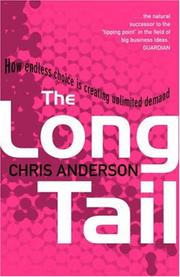
Book review
The Long Tail Review
This The Long Tail review considers Chris Anderson's business or personal growth book through reader fit, strengths, cautions, context, and related books.
- Author
- Chris Anderson
- First published
- 2006
View source
https://openlibrary.org/works/OL4091759WThe Long Tail review: platform logic without prescriptive shortcuts
This The Long Tail review treats Chris Anderson's book as an analytical map, not a blueprint for action. The Long Tail is useful in the catalog because it asks why catalogs and markets can feel larger when distribution changes, and why that shift can change what readers and businesses perceive as available.
The title sits first in business and growth with a clear bridge into philosophy and psychology, where the text raises questions about attention, desire, and decision patterns.
Thesis and analytical value
The core thesis is straightforward: systems change when abundance is handled intentionally. Anderson proposes that selection behavior can stretch when access channels widen, and that this change alters how value is discovered, compared, and held. In a library context, this claim is not only economic; it is also a reading framework for category design.
That is why this review keeps one boundary clear. This is a book that invites broad questions about ecosystems of goods and attention, but it is not a personal instruction manual. The Long Tail review should help readers test the argument, not outsource decision making to it.
Reader fit and likely response
The Long Tail review is best for readers who like to move from theory to interpretation. If your intent is strict practical investment or fixed outcomes, you may want another route. If your intent is to understand how abundance changes cultural and commercial pressure, this review offers a strong fit.
Readers may respond in two broad ways. Some readers find the argument clarifying because it explains how niche content can emerge without central gatekeeping. Others find the same argument broad and prone to overreach when projected onto every context. Both responses can be fair, which is why the review values context over endorsement.
The route works especially well for readers who use this category to test ideas about scale without assuming a universal model. That means this book can stay in tension with market history as a lens rather than a final rule.
Strengths that make the book sticky
The strongest strength is coherence of framing. Anderson traces a recurring pattern: when supply widens and storage constraints fall, attention becomes the scarce resource. That pattern is strong enough to remain useful even when the specific examples feel dated.
A second strength is comparative architecture. In business and growth the title remains useful because it can be tested against books with different emphases on execution. Thriving on Chaos and Business offer useful contrast on strategic certainty and leadership framing. Where Anderson abstracts systems, those texts can foreground managerial practice.
Third, the work also helps readers question what is being measured in modern systems. The book nudges readers toward a more deliberate vocabulary around catalog choices, audience segmentation, and audience fatigue. For a review library, this is practical.
Cautions and limits
The first limit is temporal. No single text can stay perfectly aligned with shifting platforms, payment models, and distribution channels. The Long Tail review should be used as an entry point to reasoning, not as current operational doctrine.
The second limit is interpretive overreach. Readers can accidentally treat broad theory as direct prescription, which is where this book can mislead. The book is helpful in comparison, but less useful when detached from local constraints.
The third limit is emotional tone. The prose may seem optimistic about systemic flexibility, and readers expecting a more skeptical social critique should balance it with adjacent works.
Context and style
Style is a key part of its readability. Anderson writes with synthetic clarity rather than argumentative drama. This makes the argument accessible for broader movement through the catalog and allows this review to function as an entry node.
From a pacing perspective, the book alternates observation and expansion. That rhythm is clearer when the reader keeps categories of claim separate. Some sections propose broad logic, while others provide practical intuition. The Long Tail review should remind the reader that these layers do not always move at the same speed.
In terms of catalog context, the text also supports a route toward philosophy and psychology for readers who want the human side of choice and desire. For purely strategy-first reading, this can add depth without asking for full theoretical conversion.
Alternatives and route planning
One route starts here and then moves to Thriving on Chaos to compare whether systems reduce uncertainty or create new forms of complexity. A second route goes through Leadership Wisdom From The Monk Who Sold His Ferrari to compare motivational framing and practical orientation. A third route returns to Business for a broader category anchor.
These comparisons help readers identify whether they are most interested in catalog behavior, strategic framing, or personal habit discourse. That differentiation matters because this book can support all three without collapsing into one use case.
Extended route analysis and limitations of the model
Many readers use this title to test a broad question and then ask whether systems thinking helps in adjacent fields. The answer is usually yes for comparison and no for direct transfer. This distinction is central to why the book remains useful across years while still demanding contextual judgment.
A stronger route here is to keep one shelf question constant while changing category focus. If the question is visibility, move from The Long Tail into Business and Leadership Wisdom From The Monk Who Sold His Ferrari. If the question is narrative diversity, compare with Thriving on Chaos and then return to the category home.
When readers track that same question across multiple texts, this title does one thing well: it makes it harder to confuse scale with certainty. It does not replace local decision making, and it should not be used as a shortcut around context. That is a strength, not a flaw, when the review is being used for category navigation.
Catalog usage checks
To keep this title from being overextended, readers can run three quick checks. First, identify the unit of comparison. If the unit is only personal productivity, this review should be read with caution. If the unit is cultural and informational architecture, the title is much more useful.
Second, confirm temporal framing. The book predates the current platform ecology. A reviewer can still gain insight by translating its structure to contemporary systems, as long as the time gap remains explicit.
Third, separate narrative confidence from practical certainty. The Long Tail is strong in one area and selective in another. That is not weakness; it is a practical map of scope.
Final assessment
The practical verdict for this title is that the long-term usefulness of The Long Tail review is comparative, not prescriptive. The book contributes a useful language for thinking about abundance, visibility, and demand, which is why it remains one of the steadier entries on the shelf.
For readers who want a direct template for action, this is not the strongest fit. For readers who want a stronger analytic lens that can be held alongside different works, the title earns a secure place in the catalog route.
Practical route conclusion
A practical way to use this review is through one explicit sequence. Start with this title to map where systems thinking helps, then move to Thriving on Chaos to test whether uncertainty is framed as manageable or as structural. Follow with Leadership Wisdom From The Monk Who Sold His Ferrari to compare how individual agency is framed when systems become overloaded. Finish at Business so the sequence returns to a broader operational anchor.
In this sequence, this review performs best when the reader tracks changes in assumptions between books, especially how one text moves from distribution logic to personal responsibility. That is the difference between taking a model as language for thought and taking it as an instruction. This distinction should remain visible when readers use the book to support category planning.