Book review
The Ringworld Throne Review
This The Ringworld Throne review weighs Larry Niven's ambitious return to the megastructure as a novel of ecological governance, divided communities, and uneven narrative momentum.
- Author
- Larry Niven
- First published
- 1996
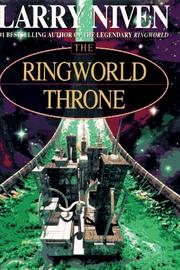
View source
https://openlibrary.org/works/OL510428WThe Ringworld Throne review: who can govern a world too large to comprehend?
This The Ringworld Throne review begins with the distinction that makes Larry Niven's third main Ringworld novel interesting and difficult: the Ringworld is no longer simply an astonishing object to discover. It is a world full of societies, inherited technologies, local conflicts, and incompatible ideas of protection. The novel asks what stewardship could mean when no single group can see the whole system, yet several powerful actors are willing to rule it.
That is a compelling development of the series. The original Ringworld review describes how Niven turns enormous scale into adventure pressure. Here, scale becomes political and ecological pressure. Louis Wu, the Hindmost, Acolyte, the Protectors, Ghouls, vampires, and several Ringworld populations occupy different positions inside the same damaged environment. Each understands only part of the crisis. Each has a different reason to act. The title's “throne” is therefore less a literal prize than a problem of legitimacy: who is qualified to preserve a world, and what kinds of violence become acceptable in the name of preservation?
The answer is not delivered with the clean momentum of the first book. Niven divides attention between local conflict among Ringworld peoples and the larger struggle around Louis Wu and the Protectors. Those strands eventually illuminate one another, but the connection takes time to become narratively urgent. The result is ambitious, sometimes fascinating, and often crowded. It is best read as a sequel for committed series readers, not as an independent entry point.
From engineering marvel to inhabited ecology
The novel's strongest conceptual move is its refusal to treat the Ringworld as empty scenery. A megastructure can easily become a tourist attraction for characters: something described at length, admired, and then left behind when the plot needs a conventional conflict. The Ringworld Throne instead insists that engineering and habitation cannot be separated. The structure's systems sustain numerous cultures, and damage to those systems is never merely technical. Maintenance decisions become questions about whose lives count and who is allowed to decide.
This shift gives the familiar setting moral weight. The Ringworld remains physically overwhelming, but the novel repeatedly reduces its scale to local consequences. Communities face predators. Travelers depend on partial knowledge. Groups interpret old machinery through their own histories. Even actors with access to advanced technology cannot simply make the world transparent. Niven's central invention becomes more convincing because it has accumulated cultural difference, not because the book adds another diagram.
There is an important tension here between the series' engineering imagination and its anthropological imagination. Niven is still drawn to mechanisms, biological adaptation, and problem solving, but he also wants to show how different populations organize survival. The best passages make these interests cooperate. A biological feature becomes a social role; a technological artifact becomes a source of power; a local custom reveals how people have adapted to the structure without understanding it as its builders might have done.
The limitation is that the social abundance can feel catalog-like. Readers meet groups and practices faster than the novel can give all of them emotional depth. The world grows broader, while the narrative center becomes harder to locate. This is a productive trade for readers who value speculative ecosystems. It will be a frustrating one for readers who need every strand to tighten the main plot immediately.
Protectors, authority, and the cost of stewardship
The Protectors concentrate the novel's political argument. They possess extraordinary capacity, but intelligence and power do not automatically produce legitimate care. A Protector is oriented toward survival, yet survival remains attached to a particular lineage or population. The Ringworld's crisis demands something broader: responsibility for a system containing peoples whose interests may collide.
That gap between capability and legitimacy is the real drama behind the title. A ruler can claim to protect the whole while defining the whole narrowly. A local victory can preserve one group while destabilizing another. The novel's strongest idea is that a world-scale problem does not create a world-scale moral consensus. It creates more opportunities for concentrated power to present itself as necessity.
Louis Wu is useful in this framework because he carries experience, guilt, and uncertainty rather than uncomplicated command. His previous involvement in the Ringworld's survival has consequences that cannot be reduced to heroic success. He has reason to doubt his own fitness and reason to distrust beings whose competence exceeds his. This makes him a more interesting mediator than a triumphant engineer would be. He knows enough to recognize systemic danger, but not enough to stand outside the moral costs of intervention.
The Hindmost introduces another form of authority: technical access mixed with self-interest and fear. Acolyte brings inherited Kzin identity into a coalition that cannot rest on easy trust. The relationships among them are often transactional, and the repeated bargaining can feel schematic. Yet the schematism fits the book's concern with alliances built under asymmetrical power. Cooperation is possible, but it is rarely innocent.
A divided structure that tests the reader's patience
The Ringworld Throne is constructed around plot lines whose connection is deliberately delayed. One follows struggles among Ringworld populations, including the threat posed by vampires and the involvement of Ghouls. Another returns to Louis Wu, the Hindmost, and the struggle among Protectors. The design has thematic logic: events understood as local and events understood as planetary eventually prove to be parts of the same system.
In practice, however, the arrangement weakens momentum. The early material asks readers to absorb names, species, customs, and tactical situations before the book has made their larger relevance clear. Niven's explanatory confidence helps with orientation at the sentence level, but clarity within a scene is not the same as urgency across the novel. The book can feel busy without feeling directed.
That pacing problem is more significant than simple slowness. A slow novel can create tension through accumulation or deepen a central consciousness. Here, the issue is dispersal. Attention keeps moving among actors who have unequal narrative weight, so the reader may struggle to decide what kind of investment the book expects. When the lines converge, the architecture becomes easier to appreciate retrospectively, but the later payoff does not erase the initial diffusion.
Readers who enjoy a broad systems view may welcome this method. It makes the Ringworld seem too populous and complicated for one hero's itinerary to contain. Readers seeking the clean exploratory vector of the first novel are more likely to feel that the sequel has replaced wonder with administrative congestion. Both reactions identify something true about the book. Its world has matured into a political ecology, but its plot has not found an equally elegant shape for that maturity.
Strengths: conceptual continuity without simple repetition
The chief strength of The Ringworld Throne is that it does not merely restage discovery. Returning to a famous invented world can produce diminishing returns when a sequel offers the same astonishment at lower intensity. Niven chooses a better question: what happens after the artifact has become a responsibility? That question lets the novel extend the series rather than imitate it.
The book also retains Niven's gift for treating speculative ideas as sources of consequence. Biological differences affect alliances. Environmental conditions reshape tactics. Technology changes what characters can know and what they can threaten. The novel's science-fiction machinery matters because it reorganizes relationships, not because it supplies decorative futurity.
Its crowdedness has a positive side as well. The Ringworld feels inhabited by histories that do not begin when Louis arrives. Local communities have dangers, knowledge, and priorities of their own. Even when individual figures remain thin, the multiplicity pushes against the fantasy that an outsider's viewpoint can define the world completely. This is an important correction to the expeditionary simplicity that often powers megastructure fiction.
Finally, the novel builds a useful bridge between adventure SF and institutional SF. Readers interested in large systems may compare it with Rendezvous with Rama review, where the unknown object retains a colder distance from human politics. Niven's Ringworld is messier because people already live within the marvel. Its mysteries have constituencies.
Cautions: continuity burden and dated human dynamics
This is not the place to start the Ringworld sequence. The novel assumes familiarity not only with the structure but with Louis Wu, the Hindmost, Kzinti, Protectors, and the consequences of earlier interventions. Explanations exist, yet knowing definitions is not the same as carrying the emotional and conceptual history. Newcomers can follow events, but they are unlikely to feel why those events matter with the intended force.
Character depth is another limitation. The cast is large, but psychological attention is selective. Many figures function primarily as carriers of cultural or biological ideas. Louis has the clearest moral burden, while others can seem designed to demonstrate a social arrangement or move a tactical sequence. Readers who prefer inward, character-led science fiction may find the novel's people less persuasive than its systems.
The sexual and gender dynamics require candid expectation setting. Some relationships and customs are framed through assumptions that can feel dated, reductive, or more interested in speculative taxonomy than in mutual interiority. These elements are not incidental for every reader, and they should not be dismissed as the inevitable price of older science fiction. They narrow the emotional range of a book that otherwise wants to imagine radical human variety.
The prose is generally functional and clear, but exposition accumulates. Niven often explains because the world genuinely requires explanation; the problem is that the novel cannot always convert that information into proportionate dramatic energy. Readers who enjoy learning a system may remain engaged. Those who want atmosphere, stylistic richness, or sustained intimacy will have fewer rewards.
Context within large-scale science fiction
The Ringworld Throne belongs to a tradition in which enormous settings allow writers to examine the limits of individual knowledge. Yet its emphasis differs from the pristine encounter narrative. In Rendezvous with Rama review, the alien structure's reserve sustains awe. In Niven's sequel, the structure is already crowded with claims. The central uncertainty is not simply what the world is, but who may act for it.
That makes A Fire Upon the Deep review another useful comparison. Vernor Vinge also works at civilization-scale, but his distributed narrative produces a stronger sense of converging velocity. Niven's book is more localized and taxonomic, interested in how communities occupy a single vast artifact. The comparison clarifies why The Ringworld Throne can feel simultaneously enormous and congested.
For another route through Niven's systems thinking, The Mote in God's Eye review shifts the pressure toward first contact, institutions, and strategic misunderstanding. Both novels care about asymmetrical knowledge and civilization-level consequences. The Mote in God's Eye is generally easier to describe as a unified encounter; The Ringworld Throne is more tangled because its conflicts grow from a world already layered with inhabitants and prior damage.
These comparisons also show why the sequel remains worthwhile despite its flaws. Few science-fiction settings are large enough to change genre emphasis across volumes. The Ringworld can support discovery, engineering crisis, anthropology, political conflict, and ecological stewardship. The third novel does not balance all of those modes cleanly, but its attempt reveals the unusual durability of the central invention.
Who should read The Ringworld Throne?
The ideal reader has completed Ringworld and The Ringworld Engineers, remembers the broad logic of Protectors, and wants the setting to become socially denser. This reader values conceptual continuity more than introductory clarity and is willing to let local story lines accumulate before their systemic importance becomes visible.
It is also a strong fit for readers interested in governance problems inside speculative infrastructure. The book repeatedly asks how authority justifies itself, how protection becomes domination, and why technical ability cannot settle conflicts of value. Those questions give the novel more substance than a simple return adventure.
Readers looking primarily for fast space opera should approach with caution. There is danger and conflict, but the route through them is crowded with explanation and divided attention. Readers seeking rich psychological realism or contemporary treatment of sexuality and gender may also find the book's imagination uneven. Its greatest freedom remains architectural and biological, not interpersonal.
The practical recommendation is therefore selective. Read the novel if the Ringworld itself has become a question you want to keep thinking about: not only how it works, but how anyone might care for it without claiming ownership of everyone inside. Skip it, or postpone it, if what you want is a self-contained showcase of megastructure wonder. The first Ringworld remains the cleaner experience for that purpose.
Final verdict
The Ringworld Throne is a substantial, imperfect sequel whose ambitions are easier to admire than its pacing. Its most valuable move is to transform the Ringworld from an engineered spectacle into a contested ecology. Niven recognizes that preserving a world is not the same as repairing a machine, because worlds contain communities that disagree about danger, authority, and survival.
The novel's divided structure and crowded cast prevent that idea from achieving maximum force. Too much of the opening feels preparatory, and too many characters remain functions within the design. Yet the eventual convergence supports a serious thesis: no intelligence, however enhanced, becomes morally adequate merely by seeing farther or acting faster.
For experienced Ringworld readers, that thesis makes the book worth the effort. It expands the setting's ethical scale even when its narrative shape is unwieldy. For newcomers, the continuity burden and diffuse construction make it a poor invitation. The Ringworld Throne is best understood as a demanding middle volume: less elegant than the landmark it follows, but genuinely interested in what that landmark becomes once people must live, compete, and govern within it.


