Book review
The Stuff of Thought Review
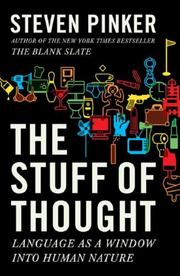
This The Stuff of Thought review examines Steven Pinker's work on language, meaning, and social reasoning, praising its sharp examples while noting that the book is strongest as a set of lenses rather than a final theory.
- Author
- Steven Pinker
- First published
- 2007
View source
https://openlibrary.org/works/OL477844WThe Stuff of Thought review: Steven Pinker at his best when language becomes social action
This The Stuff of Thought review argues that Steven Pinker's book is most rewarding when read not as a final theory of language, but as a lively, often brilliant study of what people are doing when they speak indirectly, joke, flatter, evade, insult, or negotiate. Where The Language Instinct asked readers to take language seriously as part of human nature, The Stuff of Thought asks a different and in some ways more intimate question: how do words acquire force inside real social situations? That shift gives the book its particular value on the history and ideas shelf. Pinker is not merely discussing vocabulary or grammar. He is trying to show how language becomes a medium for intention, relationship, and strategy.
That emphasis makes the book both engaging and slightly uneven in productive ways. It contains some of Pinker's sharpest public writing because the subject lets him move constantly between theory and ordinary experience. Euphemism, taboo, metaphor, innuendo, politeness, and verbal ambiguity are not fringe curiosities here. They are evidence that language is never just a clean pipeline from mind to mind. Speech carries implication, social risk, status management, and shared background assumptions. Pinker is especially good at making those layers visible without turning the book into a forbidding specialist text.
The thesis of this review is straightforward. The Stuff of Thought is one of Pinker's strongest crossover books because it makes readers hear everyday language with more precision and less innocence. It is less successful if you expect a tightly unified system that resolves every dispute about meaning, pragmatics, or cognition. Read as a set of highly intelligent lenses on how people use words in social life, it is rich and memorable. Read as a definitive settlement, it becomes more debatable than its confidence sometimes suggests.
What the book is actually about, beyond the title
The title can sound grand enough to promise a book about thought in the abstract, but Pinker is doing something more specific and more useful. He wants to understand how language relates to meaning when literal wording is only part of the story. That means paying attention to what speakers imply without stating, how listeners infer motives and intentions, and why so much communication works precisely because people do not say everything plainly.
This is where the book distinguishes itself from a simpler introduction to linguistics. Pinker is not focused mainly on sentence structure or the biological basis of language. He is interested in how speech acts function in the wild. A request may be phrased as a question. A threat may arrive as a joke. A polite euphemism may soften reality while also revealing the discomfort it is meant to hide. A taboo term may signal intimacy in one context and aggression in another. Much of the book's pleasure comes from the fact that these are recognizable situations, not remote academic puzzles.
Pinker also writes as though ordinary language deserves the same seriousness people usually reserve for law, philosophy, or formal logic. That is one reason the book has lasted. It makes readers feel that the smallest turns of phrase can expose larger structures of social reasoning. If one person says too much, too directly, or at the wrong level of explicitness, the conversation changes. If another says too little, implication rushes in to do the work. Pinker repeatedly returns to that middle zone between literal content and social effect because it is where language feels most human.
Readers coming from The Language Instinct review will notice the difference immediately. The earlier Pinker book is energized by arguments about innate capacities and the structure of language. This one feels more observational, more situational, and often more interested in interpretation than architecture. That does not make it simpler. If anything, it reveals how quickly language becomes complicated once real speakers, real listeners, and real consequences enter the frame.
Why Pinker's examples carry the book
The great advantage of The Stuff of Thought is that Pinker knows this subject cannot be explained only through terminology. He therefore builds much of the book around cases that readers can recognize without special training. Instead of asking the audience to admire theory from a distance, he stages the theory through moments of misunderstanding, wit, discomfort, or negotiation. That method keeps the book alert and readable while also making its claims feel testable against ordinary life.
His best examples do two things at once. First, they slow down familiar exchanges enough for the reader to notice their hidden machinery. Second, they show that the hidden machinery is not ornamental. It is the point. A polite indirect phrase is not a weaker version of direct speech. It may be the socially intelligible version of what direct speech would ruin. A joke is not merely entertainment. It may function as a probe, a release valve, a shield, or a way to circulate something risky without owning it fully. A euphemism does not just decorate meaning. It rearranges the emotional and social costs of saying something.
This example-driven approach is why the book works better than many broad public books on language and mind. Pinker understands that readers rarely stay with abstractions unless they can hear them in live sentences. He wants the reader to notice that communication depends on inference all the time. Literal meaning matters, but it is never enough by itself. Social knowledge, tone, status, background context, and shared norms all help determine what an utterance is actually doing.
In that sense, the book pairs especially well with The Information review. Gleick's book helps readers think about transmission, code, and abstraction. Pinker's book reminds them that even perfectly transmitted language can remain socially complex. Information is not the same thing as intention. A sentence can be clear as a sequence of words and still unstable as an act between people. That distinction is one of the most valuable habits this book teaches.
The examples also help explain Pinker's appeal as a public intellectual. He has always been good at taking a question that could sound dry and showing why it lives inside everyday life. Here that talent is operating close to its peak. He makes language feel less like a school subject and more like an ongoing social technology that everyone uses, often without noticing how much interpretation they are performing every day.
Meaning, implication, and the social intelligence of speech
The deepest payoff of the book is that it makes meaning appear layered rather than flat. Pinker is repeatedly concerned with the difference between what is said, what is meant, and what is inferred. That may sound obvious when stated that way, but many readers move through public argument, workplace language, and personal conversation as though literal wording should be enough to settle interpretation. Pinker shows why it so often is not.
This is where the book becomes more than a collection of neat observations. It offers a strong account of why communication is inseparable from social intelligence. Speakers are constantly estimating what can be said openly, what must remain implied, how much the listener already knows, and which verbal form will preserve or endanger a relationship. Listeners are doing parallel work in reverse. They are not just decoding grammar. They are inferring intention, gauging stakes, and placing utterances inside a shared world of norms and pressures.
That insight gives the book a practical seriousness. Many failures of communication do not come from poor vocabulary or faulty syntax. They come from misreading the action being performed by the words. A careful listener may understand the sentence but miss the maneuver. A careful speaker may state the facts and still fail because the level of directness is socially disastrous. Pinker does not treat these problems as minor complications added to language from outside. He treats them as central features of how language works among people.
This is also why the book makes a strong bridge to The Righteous Mind review. Haidt is concerned with moral intuition and the social texture of disagreement; Pinker, in this book, is concerned with the linguistic texture through which much of that disagreement is expressed, softened, sharpened, or disguised. The overlap is not disciplinary sameness, but it is intellectually useful. Both books push against the fantasy that human beings simply exchange transparent propositions and then reason cleanly from there.
To Pinker's credit, he usually keeps the focus on language as lived practice rather than letting the book dissolve into a vague philosophy of "everything is context." He is interested in patterned regularities, not in abolishing structure. The social intelligence of speech is not presented as chaos. It is presented as something surprisingly rule-governed once one learns where to look.
Where the book is strongest, and where it becomes more mosaic than system
The strongest case for The Stuff of Thought is that it changes the reader's ear. After spending time with it, many ordinary exchanges start to sound denser and more deliberate. One begins to hear the pressure of euphemism, the tact of indirection, the social gamble inside a joke, or the difference between a literal proposition and a practical intention. That is a real intellectual achievement. Books that permanently refine attention are rare, and this one often manages it.
It is also one of Pinker's warmest books in the sense that it stays close to scenes of everyday life. He is writing about language, but he is also writing about embarrassment, cooperation, intimacy, social distance, and negotiated risk. That gives the book a human scale sometimes missing from more architecture-heavy accounts of mind and language. Readers do not have to care about theoretical schools in order to care about what is happening here.
The limitation is equally clear. The book is often more illuminating as a sequence of strong interpretive essays than as one tightly integrated master account. Pinker is very good at revealing one phenomenon after another, but the overall structure can feel cumulative rather than fully synthesized. That is not fatal. In fact, it may be part of the book's charm. Still, readers looking for a single elegantly unified framework may feel that the book's intelligence is distributed across episodes rather than gathered into one decisive model.
There is a second caution worth stating carefully. Because Pinker writes with such confidence, some of the framing can sound more settled than it really is. Questions about language use, meaning, pragmatics, metaphor, and cognition remain large and contested. The book is valuable as a major contribution to public understanding, not as a final court of appeal. The safest way to read it is as a forceful synthesis from a particular moment in the broader conversation about language and mind.
That posture matters because it preserves what is best about the book. If you demand finality from it, you will spend too much time measuring what it does not close. If you let it operate as a set of disciplined lenses, its strengths become much easier to appreciate.
How it sits within Pinker's body of work
Among Pinker's major books, The Stuff of Thought occupies a particularly interesting middle ground. It is less foundational in reputation than The Language Instinct, less historically expansive than The Better Angels of Our Nature, and less broad in its public reach than some of his more famous titles. Yet for many readers it may be the most consistently rewarding on the page, because the subject naturally disciplines both his explanatory habits and his appetite for vivid illustration.
In earlier work, Pinker can sometimes seem most persuasive when he is making large claims at speed. Here he benefits from a narrower theater of argument. Language in use does not allow abstraction to drift too far from examples, so the writing stays closer to the grain of real interaction. The result is a book that feels less like manifesto and more like guided noticing. That is a good fit for Pinker's strengths. He remains argumentative, but the argument is embodied in scenes, forms, and patterns readers can examine for themselves.
This also makes the book a useful corrective to simplistic summaries of Pinker as merely a theorist of innate structures or big civilizational trends. The Stuff of Thought shows him attentive to pragmatics, convention, and the social choreography of speech. It reveals a writer interested not only in the existence of language, but in the way language helps people manage embarrassment, desire, authority, aggression, and affiliation.
For readers building a more complete route through his work, the most natural sequence is still to begin with The Language Instinct review and then move here. That progression clarifies what changes when the question shifts from "why humans have language" to "what humans are doing with language once they have it." After that, The Righteous Mind review makes sense as a next step, because it broadens the inquiry from speech situations to moral and social judgment more generally.
Who should read it, and who may want a different starting point
This is an excellent book for readers who enjoy serious nonfiction but do not want to live entirely inside technical specialization. It suits students of language, communication, rhetoric, psychology, education, negotiation, or cultural analysis, but it is equally good for attentive general readers who simply like books that sharpen everyday perception. If you are the kind of reader who enjoys noticing how small verbal choices change the meaning of a whole exchange, Pinker gives you a richer vocabulary for that pleasure.
It is especially strong for people who work in settings where interpretation matters constantly: teaching, editing, management, mediation, writing, coaching, law-adjacent work, public communication, or any profession in which wording can alter relationships as much as it conveys content. The book does not provide canned advice, and that is part of its value. It teaches a more general habit of noticing what speech is trying to accomplish.
It is less ideal if you want a formal introduction to linguistics, semantics, or analytic philosophy of language. Pinker is too interested in momentum and public readability for the book to function as a technical primer. Readers looking for dense scholarly method or exhaustive disciplinary mapping may find it stimulating but incomplete. They would be better served by treating it as an interpretive gateway rather than as a full course.
Reader expectation matters here. If you come for a polished public-intellectual book about language in social use, the experience is likely to be rewarding. If you come expecting an airtight system, a specialist handbook, or a current map of all relevant academic debates, the book will feel less sufficient. That is not a flaw so much as a fit question, and premium reviews should be honest about fit.
For a broader shelf-level route, best books for curious readers is the right place to continue. The Stuff of Thought belongs in that company because it does what the best idea books do: it improves later reading by refining the reader's questions.
Alternatives, companions, and the best reading pathway
The best companion depends on what you most want from this book. If the attraction is Pinker's interest in the underlying human capacity for language, then The Language Instinct review is the natural companion and probably the first adjacent title to read. It provides the structural and biological framing that sits behind some of Pinker's later concerns.
If what interests you most is the way language shapes public and interpersonal disagreement, The Righteous Mind review is a smart next move. Haidt is working in moral psychology rather than linguistics, but he helps explain why the same words can trigger different moral saliences in different audiences. Together, the books can make communication failures look less mysterious and more patterned.
If your interest lies in language as a system of transmission, encoding, and abstraction, The Information review provides a different but illuminating angle. That pairing is useful because it keeps the reader from collapsing meaning into signal or signal into meaning. Pinker helps with social force; Gleick helps with structure and scale.
There is also value in staying within history and ideas more broadly, because The Stuff of Thought is really a crossover book. It belongs not only to linguistics or psychology, but to a larger tradition of books asking how human beings convert inner life into public action. That is part of why it remains worth reading even for people who do not think of themselves as especially interested in language.
Final verdict
The Stuff of Thought is one of Steven Pinker's most satisfying books because it takes language out of the abstract and returns it to the places where readers actually meet it: conversation, conflict, politeness, humor, negotiation, embarrassment, and social inference. Its best chapters make ordinary speech feel intellectually alive. They show that words do not merely label thought after the fact. They help stage relationships, conceal pressure, preserve ambiguity, and coordinate action.
Its limitations should stay visible. This is not the final word on meaning or pragmatics, and it can feel more like an intelligent mosaic than a completely unified theory. Some readers will want a stronger technical apparatus or a more patient treatment of competing frameworks. Those are fair cautions. They do not cancel the book's achievement.
The premium judgment is strongly favorable. Read The Stuff of Thought if you want a serious, readable, memorable book about how language works once it leaves the dictionary and enters social life. Read it for the examples, for the sharpened ear it leaves behind, and for its insistence that speaking is never just saying. Pinker is at his most useful here when he helps readers notice that meaning is made not only in words, but in the risky, strategic, deeply human act of using them.


