Book review
A Hat Full of Sky Review
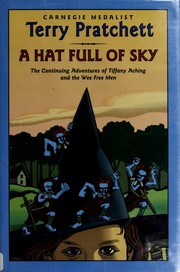
This A Hat Full of Sky review examines Terry Pratchett's sharp, unsettling Tiffany Aching novel as a coming-of-age fantasy about identity, discipline, and the fear of losing command of the self.
- Author
- Terry Pratchett
- First published
- 2004
View source
https://openlibrary.org/works/OL453737WA Hat Full of Sky review
This A Hat Full of Sky review argues that Terry Pratchett's novel is one of the strongest books in his Tiffany Aching sequence because it refuses to treat growing up as a sentimental upgrade. Instead, it presents adolescence as a period of strain: leaving home, learning a role that carries real obligations, and discovering that the self can be less stable than it once seemed. That seriousness gives the book more force than a casual description of it as "Discworld for younger readers" might suggest.
The premise is deceptively simple. Tiffany Aching leaves the Chalk to continue her witch training, and what should have been a story about apprenticeship becomes a story about interior threat. The novel's central danger, the hiver, matters not only as a fantasy antagonist but as a device for thinking about invasion, fear, and the terrifying possibility of being acted through rather than acting. Pratchett uses that pressure to sharpen questions already present in Tiffany's first appearance: what kind of attention makes a good witch, what power does responsibility require, and how does a child become a moral agent without becoming hard or hollow?
The thesis is straightforward: A Hat Full of Sky is excellent when read as a psychologically exact coming-of-age fantasy rather than a cozy comic adventure. It is witty, brisk, and often very funny, but the wit is doing structural work. It keeps the novel readable while Tiffany faces loneliness, hostility, and a form of possession that works as a metaphor for panic, self-division, and the fear of losing one's own mind. Readers who want fantasy with both clarity and edge will find a great deal here.
What the novel is really about
On the surface, this is a training novel. Tiffany goes out into the world, meets other witches, learns customs of the craft, and has to prove that she belongs. Underneath that structure, though, Pratchett is writing about perception. Witches in Tiffany's world are not glamorous spell-casters first; they are people who see what is there, including the unpleasant parts, and take responsibility for it. That gives the book a different center of gravity from fantasy that treats power mainly as spectacle.
This matters because Tiffany's education is not just technical. She has to learn hierarchy, restraint, tact, and self-command. She also has to learn how communities work: who gets overlooked, who gets judged, who quietly carries the burden when something goes wrong. Pratchett's best young reader fiction often assumes that children can understand social complexity if it is presented clearly enough, and this novel is a particularly strong example of that trust.
The hiver pushes those themes into darker territory. It is not merely an enemy to defeat. It is a force that occupies weakness, fear, vanity, and confusion. The novel's tension comes from the fact that Tiffany is strong enough to be interesting prey. Possession here is frightening because it is not only external. It works through thoughts, impulses, and distortions of feeling. Pratchett handles that material with unusual precision, making the book more unsettling than its comic surface initially suggests.
That is why the novel belongs naturally on both the fantasy and young adult shelves. Its fantasy machinery is vivid, but its real achievement is how cleanly it translates emotional and moral confusion into narrative form.
Tiffany Aching as a protagonist
Tiffany is the reason the book holds together so well. She is not built as a generic brave heroine or as a bundle of endearing quirks. Her defining trait is attention. She notices what people avoid, including in herself. That makes her unusually credible as a young protagonist confronting a threat that depends on blurred judgment. Because Tiffany has already learned to observe herself, the novel can dramatize inner disturbance without becoming vague.
Pratchett also understands that competence in a child character must come with cost. Tiffany is capable, but she is not invulnerable. Her confidence isolates her from other children. Her intelligence does not protect her from humiliation. Her sense of duty can become severity. The book gains much of its emotional texture from these tensions. Tiffany is admirable not because she is effortlessly gifted, but because her gifts place demands on her.
Another strength is that Pratchett never reduces maturity to sweetness. Tiffany learns compassion, but she also learns the harder discipline of not centering her own feelings when other people need something practical. That distinction is central to the witches books. Care is not a mood; it is labor, and often unglamorous labor. For younger readers, that is a meaningful corrective to fantasy narratives where specialness is enough. For adult readers, it is one reason the Tiffany books remain so sturdy on rereading.
The supporting cast helps illuminate these ideas rather than distracting from them. Miss Level, with her severe eccentricity, gives the training plot its odd and memorable texture. The older witches broaden the novel's sense of what womanhood and authority can look like. And the Nac Mac Feegle, as always, provide comic disruption without trivializing the danger. Their absurd energy is funny because it runs alongside real risk, not because it cancels it.
Tone, style, and the balance of humor with fear
One of Pratchett's most difficult achievements here is tonal control. A Hat Full of Sky has jokes, verbal play, and grotesque comedy, but it is not weightless. The novel is often about shame, estrangement, and mental peril. A weaker book would separate those registers too neatly: comic scenes over here, serious scenes over there. Pratchett instead lets them coexist, which makes the emotional world feel more believable.
His prose remains characteristically efficient. He can sketch a person, a village custom, or a social tension with very little wasted motion. That lightness is part of why the novel moves so quickly. Yet the speed does not mean superficiality. Pratchett's comic compression often carries a second payload of judgment. A throwaway line can expose a hierarchy, a prejudice, or a hypocrisy. This is especially important in a book about a girl moving through systems of adult authority.
The fear in the novel is also handled well. It would have been easy to make the hiver either too abstract or too melodramatic. Pratchett avoids both problems by making the threat experiential. Readers understand possession through altered mood, false certainty, swelling pride, and dislocated perception. The result is a form of fantasy horror fitted to a young audience without being diluted into harmlessness.
That tonal mixture is a major reason the book has crossover appeal. Adults can appreciate the craft with which Pratchett manages irony, folklore, and social observation. Younger readers can follow the plot and the danger clearly. Very few books manage to be genuinely accessible without flattening their themes. A Hat Full of Sky mostly succeeds.
Strengths that make the book last
The novel's first major strength is thematic focus. It knows exactly what it wants to examine: the making of a self under pressure. Everything supports that inquiry, from the training plot to the social friction Tiffany encounters to the hiver's invasive presence. The book does not feel padded with secondary machinery. It is compact, and its compactness helps its force.
The second strength is moral seriousness without preachiness. Pratchett is often interested in ethics, but his best books do not announce lessons and then decorate them. They dramatize judgment in action. Tiffany has to decide what kind of person she is when frightened, angry, tempted, or misunderstood. Those decisions matter because they affect other people. The book respects the reality that character is built from repeated acts of attention and responsibility, not from a single noble gesture.
The third strength is how sharply Pratchett writes about girlhood without reducing it to a market category. Tiffany's experience is specific. Other girls can be cruel to her, adults can patronize her, and expectations about femininity can limit or distort how others see her. But the novel does not simplify these pressures into a generic empowerment message. It is more interested in competence, authority, and the lonely work of becoming oneself.
The fourth strength is re-read value. Once you know the plot, what remains impressive is the book's structure and tonal discipline. You can see how early scenes establish Tiffany's vulnerability, how comedy releases pressure at exact moments, and how the witches collectively model different versions of power. That durability matters in a catalog full of fantasy that is enjoyable once but thin afterward.
Cautions and likely reader fit
Readers looking for a soft, whimsical fantasy should approach with calibrated expectations. The book is readable and often playful, but it is not primarily gentle. Its central conflict involves possession, identity disturbance, and intense fear. Younger or more sensitive readers may find parts of it genuinely unsettling, especially because the danger feels psychological rather than remote.
A second caution is that this is not the most expansive version of Discworld. Readers who come to Pratchett chiefly for broad satire, large civic ensembles, or the elaborate social machinery of his adult Discworld novels may find this one narrower. That narrowness is mostly a strength, since the book stays tightly aligned with Tiffany's consciousness, but it does mean the pleasures are more concentrated and intimate than panoramic.
There is also a particular kind of reader mismatch worth naming. If you want fantasy training to function mainly as a ladder toward bigger magical battles, the novel may feel understated. Witchcraft here is practical, local, social, and bound up with care work. The climactic stakes are real, but the book's deepest interest lies in inward mastery rather than external escalation.
For the right reader, though, these are not weaknesses. This book is especially well suited to readers who like crossover fantasy with psychological precision, to younger readers ready for darker emotional material handled responsibly, and to adults who want a compact Pratchett novel with unusually strong thematic coherence.
Context within Discworld and useful comparisons
Within Discworld, Tiffany Aching occupies a distinct lane. These books are not side products of the main sequence; they are among Pratchett's most disciplined explorations of ethics, community, and growing into power. A Hat Full of Sky deepens that project by showing Tiffany away from home, where identity is less supported by familiar ground and more vulnerable to fracture.
That makes the novel a good bridge for readers who are curious about fantasy beyond pure wonder or quest momentum. If what you value most is the shape of apprenticeship under moral pressure, The Castle of Llyr offers a useful contrast in how younger fantasy handles training, responsibility, and movement toward adulthood. If you want something lighter, more overtly enchanted, and far less psychologically severe, The Magic Faraway Tree shows a very different tradition of youth fantasy, one driven more by episodic marvel than by inner threat.
For readers interested in adolescence as a test of identity rather than only a test of survival, Into the Wild is an instructive comparison from outside fantasy. The books are obviously different in genre and method, but both care about what happens when a young person pushes away from the known world and discovers that freedom is inseparable from exposure. That contrast can clarify what Pratchett is doing especially well: he translates existential vulnerability into a mythic but still intimate narrative form.
More broadly, the novel helps define what a strong young adult crossover book can look like. It does not talk down, flatten its language, or dodge the fact that fear can deform perception. At the same time, it remains lucid and purposeful. That balance is rarer than it should be.
Final assessment
A Hat Full of Sky is one of Terry Pratchett's most impressive shorter novels because it combines comic intelligence with a remarkably exact account of what it feels like to become responsible for oneself. Its fantasy plot is vivid, but its real subject is identity under strain: how a young person learns to tell the difference between power, performance, panic, and judgment.
The book's strengths are substantial. Tiffany is an excellent protagonist, the hiver provides real dread, and the novel's moral clarity never turns stiff or instructional. Its cautions are equally clear. Readers wanting pure whimsy, broader Discworld satire, or action-forward magical spectacle may find it more inward and more unsettling than expected.
For readers open to its register, though, this is a first-rate crossover fantasy: serious without pomposity, funny without evasiveness, and emotionally exact without becoming heavy-handed. It earns its place not just as a good Tiffany Aching novel, but as one of Pratchett's clearest demonstrations that books for younger readers can be sharp, dark, and critically alert while remaining wholly readable.


