Book review
The war in the air Review
A title-specific reading of Wells's 1908 catastrophe through Bert Smallways, mass air warfare, imperial rivalry, technological prediction, civil collapse, and racist geopolitical fantasy.
- Author
- H. G. Wells
- First published
- 1908
View source
https://openlibrary.org/works/OL52253WThe war in the air review: Bert Smallways beneath the machines
This The war in the air review treats the lower-case styling of the source title as less important than the ordinary man at its centre. Bert Smallways is a bicycle-minded, commercially hopeful Englishman, not a strategist, inventor, or chosen saviour. When accident carries him into the machinery of a German aerial campaign, H. G. Wells gains a deliberately inadequate witness to global war. Bert cannot master what he sees. That limitation is the novel's point: industrial conflict has outgrown the scale at which a citizen can understand, influence, or escape it.
The aircraft are spectacular, but Wells steadily strips spectacle of triumph. Air fleets can cross borders and strike cities; they cannot guarantee a functioning political order afterward. Communication, food supply, credit, transport, and public confidence fail together. The book's strongest prediction is therefore not a particular vehicle. It is the imbalance between humanity's ability to project violence and its ability to preserve the systems on which everyday survival depends.
A bicycle shop opens onto global catastrophe
Bert's prewar world is comic, provincial, and already under pressure from technical change. His association with bicycles and his promotional ambitions place him among people trying to make a living from mobility without controlling its direction. Wells uses that small commercial life as a baseline. Air power arrives not as the next exciting product but as a scale change so severe that the habits of peace become almost instantly obsolete.
An accidental ascent in a balloon places Bert where he does not belong and leads to his entanglement with Prince Karl Albert and the German air fleet. The device is improbable in the lively manner of early scientific romance, yet it serves a precise narrative purpose. A military account would organize the war into objectives and commands. Bert's account encounters fragments: uniforms he cannot trust, machines he barely comprehends, orders issued above his station, and devastated places whose strategic meaning matters less than the problem of staying alive.
His ordinariness also blocks the easy conversion of suffering into heroism. Bert improvises and sometimes survives through quick judgment, but he does not redeem the conflict. Readers who like socially grounded speculation can follow a different branch of the genre through Where Late the Sweet Birds Sang, where the threat unfolds through reproduction and community rather than aerial conquest.
Air power enlarges war and shrinks control
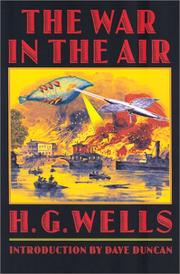
The German assault on the United States, including the attack on New York, supplies the novel's most memorable panorama. Wells grasps that flight changes geography: seas and fortifications no longer provide the same protection, and populations far from a traditional front can become immediate targets. Yet he refuses the comforting conclusion that the side with an early technical advantage will rule securely. Other powers adapt, retaliation spreads, and the air becomes a medium for escalation rather than stable supremacy.
This distinction separates the novel from simple prediction scorecards. Its dirigibles and flying machines belong to an imagined technological path, not a blueprint of later aviation. What remains recognisable is the strategic temptation: because a weapon can reach a centre of power, leaders assume that striking the centre will produce obedience. Wells instead shows destruction multiplying uncertainty. A city can be bombarded without being governed. An enemy's fleet can be damaged without restoring the markets, farms, and networks that war has broken.
The resulting action often feels intentionally disorienting. Readers who want close tactical logic may find the campaigns compressed or implausible. Those willing to read scale itself as the subject will see why the panoramic excess matters. Air war abolishes the protected spectator, including the reader who hoped to admire machines from a safe imaginative distance.
The Great Collapse is the real antagonist
The later movement toward the Great Collapse completes the book's argument. Global civilization proves more interconnected than its governments understand. Once industrial powers attack one another's material base, the damage propagates beyond any planned victory. Scarcity, disease, broken transport, local violence, and political fragmentation succeed the first rush of military news. The war does not end cleanly because the institutions capable of making and enforcing an ending have been consumed.
Wells's emphasis here is bracing. Catastrophe is neither one explosion nor one defeated capital. It is the loss of maintenance. Ordinary life depends on innumerable routines—delivering food, repairing roads, circulating reliable information, sustaining trust—and the air fleets are excellent at interrupting them. They offer almost nothing with which to replace them. Bert's struggle to return to England makes this systemic claim bodily: distance that machines crossed in triumph becomes painfully difficult for a displaced individual to cross in reverse.
For a more optimistic early encounter between invention and adventure, Columbus of Space offers a revealing contrast. Wells is far less interested in the vehicle as a promise of mastery. His machines expose political immaturity.
Prediction, warning, and the limits of hindsight
Calling the novel prophetic can obscure its craft. Wells did anticipate that aerial warfare would transform civilian vulnerability, but he was writing amid visible developments in balloons, airships, engines, newspapers, imperial arms races, and mass industry. He extrapolated tendencies. The impressive act was to connect them: mobility plus nationalism plus fragile infrastructure could produce a conflict whose consequences no cabinet could contain.
He also misjudged much, as speculative writers inevitably do. Hardware developed along different lines; actual twentieth-century wars followed histories no novel could pre-script; states sometimes proved more resilient and administratively capable than the book allows. Treating every resemblance as a fulfilled forecast turns literature into a guessing contest and misses the cautionary structure. Wells asks what happens when political imagination lags behind technical capacity. That question survives the inaccuracies.
The book also anticipates media saturation. News of distant events creates excitement and panic without giving citizens a dependable grasp of the whole. Bert moves through rumours and partial perspectives. A world newly compressed by machines remains epistemically fractured. In that sense, speed does not create shared understanding; it makes errors travel faster.
Empire criticising empire
The warning is not politically innocent. Britain, Germany, the United States, Japan, and China enter a geopolitical imagination shaped by empire. Wells can expose the vanity of military powers while still treating the world as a contest among civilizational blocs. Most seriously, Asian forces are represented through the racist conventions often grouped under the Yellow Peril: demographic fear, cultural othering, and fantasies of an undifferentiated threat.
Those elements are not detachable decoration. They help the novel generate its image of worldwide danger, which means the critique of militarism sometimes borrows the very racial panic it ought to interrogate. British assumptions are satirized, but England remains the emotional home to which Bert tries to return. Colonized people rarely receive the ordinary, individuated perspective that makes Bert valuable.
Historical context explains how such imagery circulated in 1908; it does not neutralize it. A modern reading should ask why some populations appear as persons caught in systems while others become a mass used to frighten the audience. Readers exploring the history of speculative politics may also visit science and nature, while keeping in mind that scientific language has often been recruited to naturalize political prejudice.
Reader fit: catastrophe rather than combat romance
The novel will work best for readers who tolerate digressive exposition, abrupt geographic expansion, and a protagonist whose value lies in limited understanding rather than commanding charisma. It offers striking set pieces, but the payoff is cumulative bleakness. Anyone seeking an elegant campaign narrative or richly interior character study may find its scale exhausting.
Its rewards are different. Bert makes the destruction legible from below. The air fleets demonstrate the seduction of reach. The collapse reveals that a civilization is not identical with its weapons, monuments, or leaders; it is a web of repeated cooperative acts. That vision places the book firmly within science fiction even where its machines now look antique.
The War in the Air finally deserves attention not because Wells saw the future whole, but because he understood a recurring asymmetry. Societies celebrate the technology that lets them act at a distance and neglect the social knowledge needed to live with the consequences. Bert Smallways, carried helplessly across that distance, is the right witness to the mistake.


